MERCY CORPS INTERNATIONAL
SECOND QUARTERLY REPORT FOR USG FY 2011
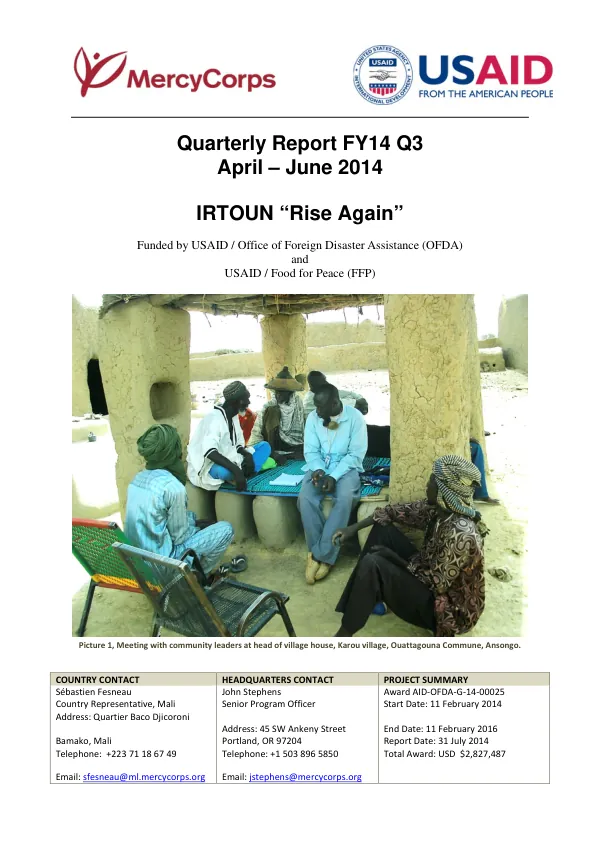
The Irtoun program, funded by USAID's Office of Foreign Disaster Assistance (OFDA) and Food for Peace (FFP), aims to enhance food security and economic resilience in communities recovering from conflict in Ansongo, Northern Mali.
2014 · 8 pages
Sign in to readA free account is required to download.
Abstract
The program's objectives are to help vulnerable households recover productive agro-pastoral livelihoods and allow vulnerable households to restore income-generating activities and withstand economic shocks. Implementation of the program's activities began in February 2014, with a focus on addressing immediate food security needs through food vouchers-for-work and animal feed vouchers. The program also focuses on the recovery of market gardening activities, including cash crops, and addresses the needs of pastoralists for improved fodder and health care services for their livestock. Additionally, the program assists micro-entrepreneurs affected by insecurity through business training and a small cash injection to restart their businesses. During the third quarter of FY14, the program achieved several key milestones. Distribution of 160 tons of emergency animal feed to 1,000 vulnerable agro-pastoralists was completed, and refresher trainings for 15 Community Animal Health Workers (CAHWs) were conducted in partnership with the Ansongo livestock technical services. Existing farmers' and gardening associations were identified and will participate in training and receive inputs in time for the planting season. Planning of Voucher for Work projects for rehabilitation of agricultural lands in communities was also completed, and a call for proposals for micro-entrepreneurial support was issued, with 150 expressions of interest received for trainee/grantees in Ansongo and Bara communes. The program's performance summary indicates that 9,359 beneficiaries (1,000 households) were reached in the third quarter, with a total of 25,060 beneficiaries (3,580 households) targeted for the entire program. The program's budget for the Agriculture and Food Security sector is $1,375,056, with a total of $354,819 allocated for the Economic Recovery and Market Systems sector. The program's indicators for the Agriculture and Food Security sector show progress towards the target of 2,000 animals benefiting from livestock activities, with 2,000 animals currently benefiting. The program's indicators for the Economic Recovery and Market Systems sector show no progress towards the target of 12,250 individuals (1,750 households) benefiting from livelihoods restoration activities, due to temporary programmatic activities being put on hold due to insecurity. The security situation in the northern regions of Mali remains volatile, with heightened tensions culminating in armed clashes in the city of Kidal in May and the withdrawal of the Malian army from the city of Menaka. This has led to an overall slowdown of the return of the displaced population. Mercy Corps' programmatic activities in Ansongo were temporarily put on hold due to insecurity, and intergroup conflicts throughout the pastoral zone of the Ansongo circle have been observed. Isolated acts of banditry have also been reported, affecting poor traders and travelers. The situation remains precarious for smallholder farmers, with many producers not returning to their fields due to a combination of factors including banditry and violence, lack of money, loss of assets, and lack of agricultural inputs since the beginning of the crisis in 2012.