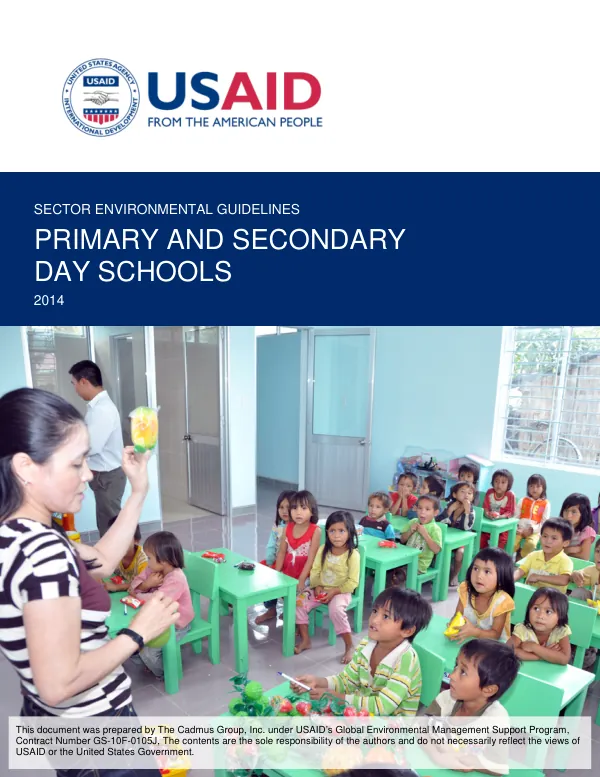
THE CADMUS GROUP, INC.
Sector Environmental Guidelines: Livestock
The livestock sector plays a vital role in the growing global population and millions of farmers in the developing world.
2014 · 30 pages
Sign in to readA free account is required to download.
Abstract
Livestock offer many benefits, including food, materials, income, and mechanical power for pulling carts, drawing water, or plowing fields. Asia has been identified as the developing region where the demand for livestock products is expected to rise most rapidly. Livestock manure can serve as a source of fertilizer, and grazing can help sustain vegetation and promote biodiversity by dispersing seeds, controlling shrub growth, breaking soil crusts, stimulating grass growth, and improving seed germination. Livestock production can be categorized under three main systems: grazing, mixed farming, and industrial. Grazing systems generally rely on native grassland, forests for fodder, with little or no use of crops or imported inputs, and are traditionally managed by pastoralist communities. Mixed farming systems integrate livestock and crop production, adding livestock to their farms helps farmers to minimize risk through more diversified production systems and extract value from otherwise valueless or low-value by-products of each activity. Industrial production systems concentrate livestock populations in special facilities and separate their feeding and waste processing from the land on which they live. More than a quarter of the world's land area is used for livestock as part of grazing or mixed farming systems, and another fifth of the world's arable land is used to grow grains for livestock feed, primarily for industrial systems. Grazing systems are most favored in arid, semi-arid, or other areas of marginal value for crop-based agricultural production, and occupy 26% of the earth's ice-free land surface. Extensive grazing systems cover the dry areas of Africa, Asia, Australia, and North America, and are characterized by grazing livestock in communal, sparsely populated areas. Mixed farming systems flourish in temperate, subhumid, humid, and some highland climates and can be rain-fed (mainly in Europe and the Americas) or irrigated (eastern and southern Asia). Industrial production, because it does not depend on local fodder supplies, can be conducted in any climate and generally occurs near the urban centers it supplies. Industrial systems are common in Europe, North America, southeast Asia, and Latin America and are becoming more prevalent as a response to growing livestock demand. In response to growing demand for livestock products, livestock production is increasing throughout the developing world, with highest production growth exhibited in China and Brazil between 1980 and 2007. This increase is driven by growing population, increasing urbanization, and rising incomes. A shift towards industrial production—farming of monogastric species (pigs, poultry) fed with grain—may be an unavoidable trend in areas with rapidly growing demand for animal food products. Properly managed, livestock production can enhance land and water quality, biodiversity, and social and economic well-being. However, when improperly managed, livestock production may cause significant economic, social, and environmental damage. The potential environmental impacts of livestock production include soil erosion, water pollution, loss of biodiversity, and greenhouse gas emissions. Climate change is also a significant concern, as livestock production contributes to greenhouse gas emissions through the release of methane and nitrous oxide. To mitigate these impacts, best management practices (BMPs) can be implemented, such as rotational grazing, manure management, and conservation tillage. Additionally, BMPs can help to minimize vulnerability to climate change by promoting soil health, reducing erosion, and conserving water. The Sector Environmental Guidelines for Livestock provide information essential to assessing the potential impacts of livestock production and identifying and designing mitigation and monitoring measures. The guidelines are advisory only and are not official USAID regulatory guidance or policy. However, they can provide valuable guidance for stakeholders, including project designers, implementers, and managers, to ensure that livestock production is carried out in an environmentally sound manner.