MIYAMOTO INTERNATIONAL, INC.
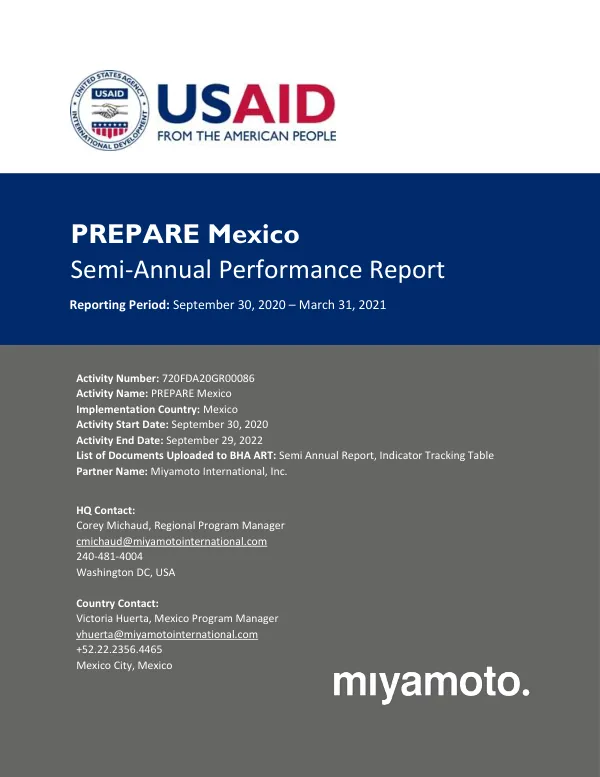
Semi-Annual Performance Report: Ecuador Building Resilience Program II
The Ecuador Building Resilience Program II (EBRP II) was launched on September 25, 2019, with a total program budget of $1,350,000.
2020 · 14 pages
Sign in to readA free account is required to download.
Abstract
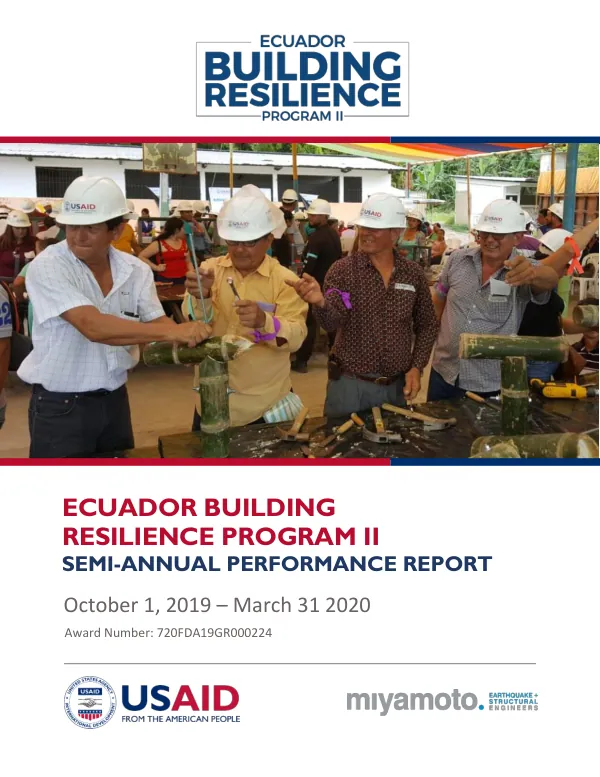
The program is implemented by Miyamoto International, Inc. in the Provinces of Manabí and Esmeraldas, in coastal Ecuador, over an 18-month period. The program end date is March 24, 2021. The program's goal is to strengthen knowledge of seismic risk, facilitate access to and diversify the use of vulnerability and exposure data, and provide training and technical assistance in seismic-resistant construction and other disaster risk reduction (DRR) best practices. The program's objectives are to help low-income populations gain access to knowledge and technical support for the use of seismic-resistant construction materials and techniques in selected areas of high earthquake risk, and to strengthen municipal and local DRR and emergency response capacity through facilitated review and incorporation of seismic hazard and vulnerability data into the public policy and planning framework. Miyamoto implements EBRP II in close collaboration with government partners, including national, provincial, and municipal units of the Secretary of Disaster Risk Management (SGR), and the Ministry of Urban Development and Housing (MIDUVI). The program also cooperates with several international partners, including the European Investment Bank (EIB) through GOPA Consultants, and the International Bamboo and Rattan Organization (INBAR). At the local level, EBRP II personnel work closely with existing community leadership structures and decentralized autonomous governments (GADs) to plan and coordinate community assemblies, facilitate beneficiary selection, reinforce key messages from technical training, facilitate post-training technical assistance, and act as a sounding board for adjustments to training and communication materials and activities. The program also emphasizes strong private sector collaboration, having met with representatives from several construction companies active in the Government of Ecuador's earthquake reconstruction and housing initiatives. Technical training under Objective 1 follows several weeks of community mobilization to promote the program and register participants. The training strategy features a strong focus on learning-by-doing, culminating in participant-led construction of a bamboo prototype structure in each of the target cantons. The 20-hour curriculum, which was updated to incorporate partner feedback and lessons learned from the first phase of EBRP in 2017-18, is delivered to a minimum of 500 masons, semi-skilled construction workers, and low-income homeowners in eight to ten communities of Manabí and Esmeraldas provinces. By the end of the program, it is expected that trained homeowners and masons will apply knowledge and skills in seismic-resistant construction to support ongoing earthquake reconstruction and housing initiatives by the Government of Ecuador and other funders. In Portoviejo, public policy related to urban planning, rural development, land use management, infrastructure, and other areas of municipal governance will be strengthened through the incorporation of up-to-date risk data, combined with the development or enhancement of risk management protocols and planning instruments. The EBRP II semi-annual performance report covers activities carried out from September 25, 2019, through March 31, 2020. During this period, Miyamoto and local partners delivered instruction in low-cost, low-tech methods, including innovative techniques using bamboo, to strengthen seismic resistance in local construction practices. The program's activities and outcomes are expected to contribute to the strengthening of knowledge of seismic risk, facilitation of access to and diversification of the use of vulnerability and exposure data, and provision of training and technical assistance in seismic-resistant construction and other DRR best practices.