USAID DEC
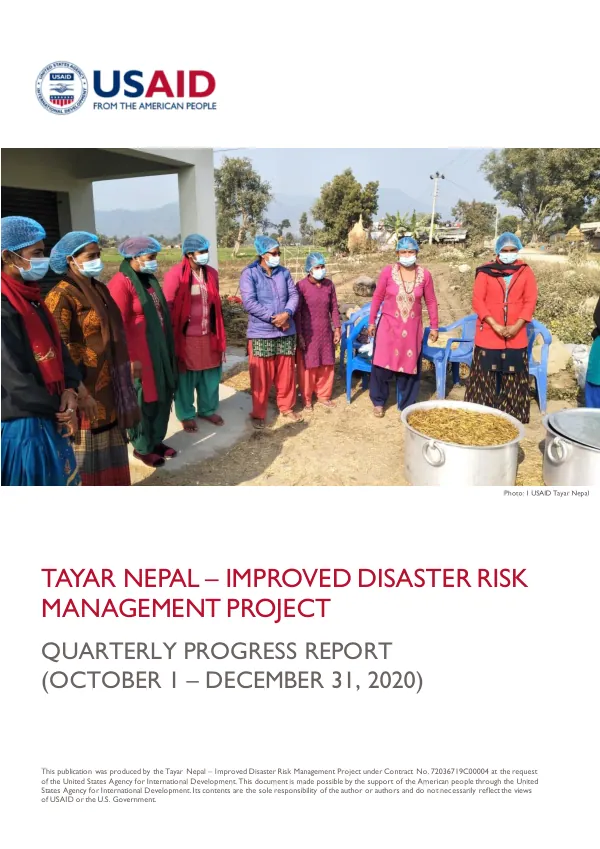
Tayar Nepal – Improved Disaster Risk Management Project Quarterly Progress Report (October 1 – December 31, 2020)
Sign inDAI GLOBAL, LLC
Tayar Nepal – Improved Disaster Risk Management Project Quarterly Progress Report (October 1 – December 31, 2020)
The Tayar Nepal – Improved Disaster Risk Management Project is a USAID-funded initiative aimed at enhancing disaster risk management in Nepal.
2021 · 53 pages
Sign in to readA free account is required to download.
Abstract
The project, which began in 2019, focuses on improving national-level systems and institutions, building capacity at the municipal level, and strengthening disaster preparedness, response, and recovery. The project's country situation analysis highlights the vulnerability of Nepal to natural disasters, including earthquakes, landslides, and floods. The country's geography, with its rugged terrain and dense population, exacerbates the risk of disaster-related losses. The project's objectives are to enhance the country's disaster risk management capacity, improve the resilience of communities, and promote economic recovery. Component 1 of the project focuses on improving national-level systems and institutions. This component involves enhancing national-level knowledge and understanding of good disaster risk management practices, generating unique scalable approaches, and cultivating champions. The project has established a project advisory committee to provide guidance and oversight. Component 2 of the project focuses on building capacity at the municipal level. This component involves enhancing municipal-level institutional setup and legislative arrangements, building municipal-level disaster risk management capacity, carrying out risk-sensitive land use planning, implementing replicable disaster mitigation activities, and promoting disaster risk finance innovation and private sector engagement. The project has also established activity 2.6, which focuses on continuation from short-term socio-economic recovery to long-term resilience building in communities. Component 3 of the project focuses on strengthening disaster preparedness, response, and recovery. This component involves task order 1, which aims to enhance the country's disaster preparedness, response, and recovery capacity. The project has also established a cross-cutting consideration section, which focuses on integration, project communications, gender and social inclusion, monitoring, evaluation, and learning. The project has made significant progress in the first quarter of 2021. The project has established a strategic communications and outreach plan, which aims to enhance the project's visibility and promote its activities. The project has also established a set of MEL indicators and targets for component 1, which will be used to monitor and evaluate the project's progress. The project's budget information is provided in section 7 of the report. The project has also established a sustainability plan and exit strategy, which outlines the project's plans for sustaining its impact and exiting the project. The project has also established a set of acronyms and abbreviations, which are used throughout the report. These acronyms and abbreviations include AHAG, AOI, APS, BASE, BIPAD, BWSN, C3, CCA, CDS-IOE, CE, COLARP, COVID-19, CSR, DEM, DFID, DHM, DIDRR, DIMS, DoS, DPNet, DPRP, DRM, DRRM, DRRMA, EDMS, EOC, EPR, EU, FAYA, EWS, FESMI, FWEAN, GESI, GiHA, GIS, GoN, HH, HICODEF, ICIMOD, and others.