AED
Semi-Annual Report No. 5: April 1, 2011 – September 30, 2011
The Capable Partners Program (CAP) Mozambique implemented a Quick Impact Program (QIP) to enhance the capacity of NGOs/CSOs in Mozambique.
2011 · 4 pages
Sign in to readA free account is required to download.
Abstract
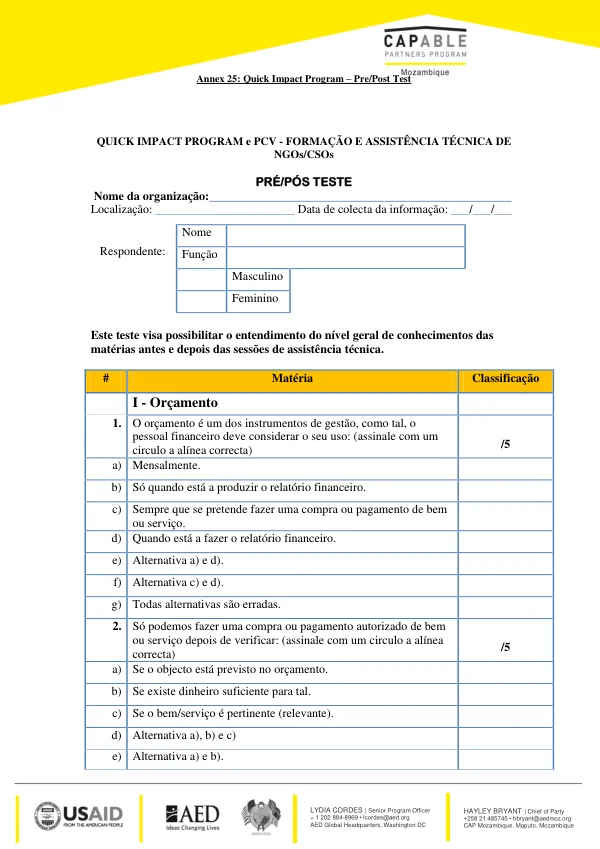
The program aimed to improve the understanding of financial management concepts among participants. A pre/post-test was conducted to assess the level of knowledge before and after the technical assistance sessions. The pre/post-test consisted of multiple-choice questions covering various financial management topics, including budgeting, bookkeeping, and cash management. The questions were designed to assess the participants' understanding of financial instruments, such as the budget, book of bank, book of cash, and book of expenditure. The budget is a crucial financial instrument that requires careful management. According to the pre/post-test, the correct answer to the question "When should the budget be used?" is option c) "Whenever it is intended to make a purchase or payment of goods or services." This indicates that the budget should be used as a guiding tool for financial decision-making. The book of bank is another essential financial instrument that helps organizations control their finances. The correct answer to the question "What should be recorded in the book of bank?" is option b) "All movements of entry and exit of money from the bank and the cash box." This highlights the importance of recording all financial transactions in the book of bank. The book of cash is a financial instrument that helps organizations manage their cash flow. The correct answer to the question "What should be done with the cash in the book of cash?" is option d) "The cash in the book of cash should be checked by the cashier." This emphasizes the need for regular cash checks to ensure accurate financial records. The book of expenditure is a financial instrument that helps organizations track their expenses. The correct answer to the question "What is recorded in the book of expenditure?" is option b) "The total amount spent during the period and globally in a given line of budget." This highlights the importance of recording expenses in the book of expenditure to monitor the budget. The Quick Impact Program (QIP) aimed to improve the financial management capacity of NGOs/CSOs in Mozambique. The program's success was measured by the participants' understanding of financial management concepts, as assessed through the pre/post-test. The results of the pre/post-test indicate that the program was effective in enhancing the participants' knowledge of financial management concepts. The QIP was implemented from April 1, 2011, to September 30, 2011. The program's impact was measured through the pre/post-test, which assessed the participants' understanding of financial management concepts before and after the technical assistance sessions. The results of the pre/post-test indicate that the program was effective in enhancing the participants' knowledge of financial management concepts.