USAID
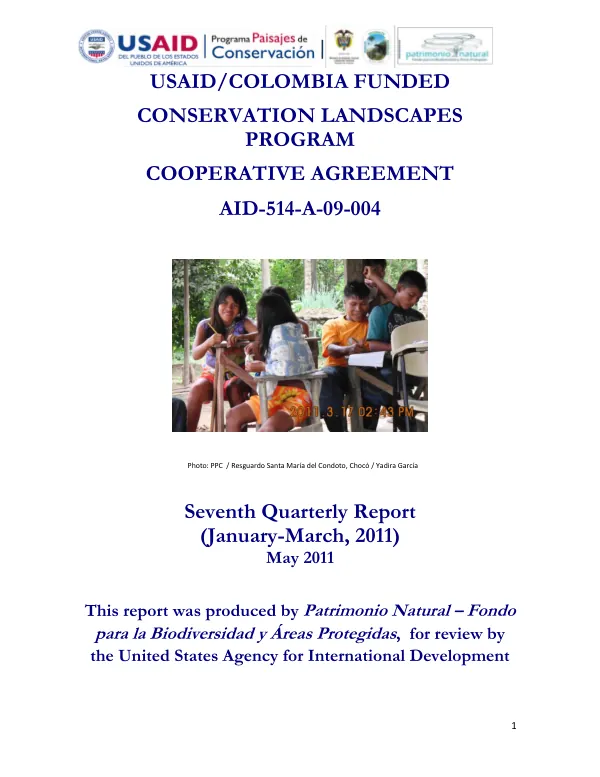
Seventh Quarterly Report (January-March, 2011)
The Conservation Landscapes Program in Colombia began its implementation in 2011 with the goal of promoting sustainable land use practices and conservation of natural resources.
2011 · 46 pages
Sign in to readA free account is required to download.
Abstract
The program is funded by the United States Agency for International Development (USAID) and is implemented by Patrimonio Natural – Fondo para la Biodiversidad y Áreas Protegidas. Progress of activities during the seventh quarter (January-March 2011) has been substantial, although uneven in some areas. Different circumstances have restricted or facilitated the completion of some tasks, while an important portion is in progress. Two parks, Catatumbo and Utría, have been subject to important changes, as new managers have been hired. A transitional period in Catatumbo, without a replacement for over two months, was deleterious, affecting the implementation of sustainable production systems. Despite these challenges, significant achievements have been made during this reporting period. Assessments, farm planning, and plot preparation in Sierra Nevada de Santa Marta have been successful. Visits were made to campesino and indigenous farms in this area to confirm their interest in implementing sustainable production systems. Tools and materials were acquired for 124 families, and some of the land preparation work was collective, benefiting 113 families. Of these families, 111 began plot clearing and soil preparation for food security plots and sugar cane cultivation. In addition, campesino families in the Lengüeta sector began their farm planning process and soil analysis in 63 farms, where agroforestry plots with cacao will be planted as an alternative for restoring soils formerly planted in illicit use crops. The total area for this land use planning process is 900 hectares. Special areas that require restoration activities are the banks of the Don Diego and Palomino rivers, where an initial diagnostic phase was begun for a 40-hectare area. The program has also made progress in implementing sustainable production systems with the Bari people in Catatumbo. Four agricultural units, benefiting 25 families in the communities of Corronkayra, Isthoda, Beboquira, and Pathuina, began their implementation. These units are mainly food security plots, and some traditional plants for different uses. Introduced medicinal plants, which they also use for their food and health needs, were planted, and bags were prepared to grow traditionally important plants. The program's institutional strengthening is well underway, with important advances in territorial planning, sustainable production systems, capacity-building events, participation of local organizations, and the development of ecotourism regulations and activities for its promotion. However, some strategic documents that would have been delivered in the first quarter are still in extensive review processes, hampering the advancement of indicators related to the Strategic Plan. The program's activities for the next quarter include continuing to plant food security species in the plots prepared in Catatumbo, as well as training workshops for the Bari people. The program's overall goal is to promote sustainable land use practices and conservation of natural resources in Colombia, and it is expected that the program's activities will continue to make progress in achieving this goal.
Related documents