USAID DEC
Site Identification and Development Initiative (SIDI) Mozambique HIV Incidence Studies
Sign inFAMILY HEALTH INTERNATIONAL
Site Identification and Development Initiative (SIDI) Mozambique HIV Incidence Studies
The Site Identification and Development Initiative (SIDI) in Mozambique was established to develop new research sites for HIV prevention research.
2011 · 1 pages
Sign in to readA free account is required to download.
Abstract
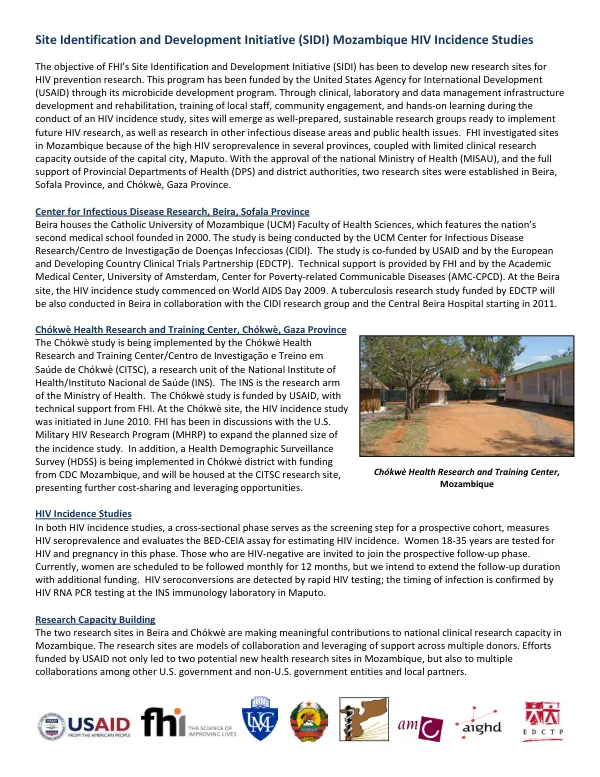
Funded by the United States Agency for International Development (USAID) through its microbicide development program, the initiative aimed to create well-prepared, sustainable research groups capable of implementing future HIV research and other infectious disease studies. Two research sites were established in Beira, Sofala Province, and Chókwè, Gaza Province, with the approval of the national Ministry of Health (MISAU) and the support of Provincial Departments of Health (DPS) and district authorities. The Beira site is housed at the Catholic University of Mozambique (UCM) Faculty of Health Sciences, which features the nation's second medical school founded in 2000. The study is being conducted by the UCM Center for Infectious Disease Research/Centro de Investigação de Doenças Infecciosas (CIDI), with co-funding from USAID and the European and Developing Country Clinical Trials Partnership (EDCTP). The Chókwè study is being implemented by the Chókwè Health Research and Training Center/Centro de Investigação e Treino em Saúde de Chókwè (CITSC), a research unit of the National Institute of Health/Instituto Nacional de Saúde (INS). The INS is the research arm of the Ministry of Health, and the Chókwè study is funded by USAID with technical support from FHI. Both research sites are conducting HIV incidence studies, which involve a cross-sectional phase followed by a prospective cohort study. The HIV incidence studies in both Beira and Chókwè are designed to measure HIV seroprevalence and evaluate the BED-CEIA assay for estimating HIV incidence. Women aged 18-35 years are tested for HIV and pregnancy in the cross-sectional phase, and those who are HIV-negative are invited to join the prospective follow-up phase. The follow-up phase involves monthly testing for 12 months, with plans to extend the duration with additional funding. HIV seroconversions are detected by rapid HIV testing, and the timing of infection is confirmed by HIV RNA PCR testing at the INS immunology laboratory in Maputo. The two research sites in Beira and Chókwè are making significant contributions to national clinical research capacity in Mozambique. The research sites are models of collaboration and leveraging of support across multiple donors, and efforts funded by USAID have led to multiple collaborations among other U.S. government and non-U.S. government entities and local partners.
Related documents