USAID DEC
Sixth Quarterly Progress Report and Annual Report: Transforming Market Systems Activity
Sign inACDI/VOCA
Sixth Quarterly Progress Report and Annual Report: Transforming Market Systems Activity
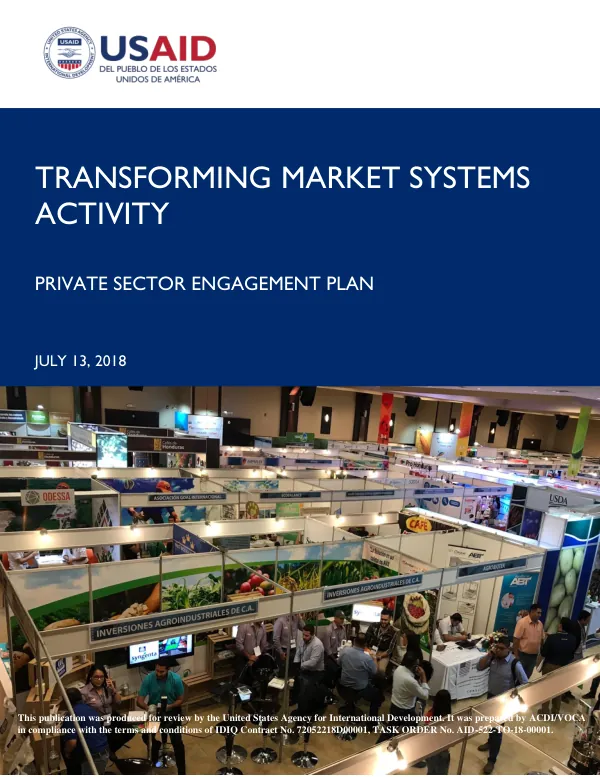
The Transforming Market Systems Activity (TMS) is a USAID-funded program aimed at fostering competitive, resilient, and inclusive market systems in Honduras.
2019 · 49 pages
Sign in to readA free account is required to download.
Abstract
The program's purpose is to provide increased economic opportunities for poor and marginalized Hondurans, reducing incentives to migrate. TMS prioritizes investments based on U.S. Government strategic interests, objectives, and ongoing investments, as defined in the USAID/Honduras Country Development Cooperation Strategy (CDCS). The program focuses on four key components: Value-Added Agriculture, Tourism and Creative Industries, Entrepreneurship, and Business Enabling Environment. The Value-Added Agriculture component aims to improve agricultural productivity and market access for smallholder farmers. The Tourism and Creative Industries component seeks to increase the competitiveness of the tourism sector and promote the development of creative industries. The Entrepreneurship component focuses on supporting micro, small, and medium enterprises (MSMEs) to improve their competitiveness and access to markets. The Business Enabling Environment component aims to improve the regulatory environment and reduce bureaucratic barriers to business growth. During the fourth quarter of fiscal year 2019, TMS made significant progress in all four components. In Value-Added Agriculture, TMS supported the development of a value chain for coffee, which resulted in improved yields and prices for smallholder farmers. In Tourism and Creative Industries, TMS worked with the Honduran National Chamber of Tourism to develop a marketing strategy for the tourism sector, which led to an increase in tourist arrivals. In Entrepreneurship, TMS provided training and technical assistance to MSMEs, resulting in improved competitiveness and access to markets. In Business Enabling Environment, TMS worked with the Honduran government to improve the regulatory environment and reduce bureaucratic barriers to business growth. TMS also made progress in monitoring, evaluation, and learning, with a focus on collaboration, learning, and adapting. The program implemented a monitoring and evaluation system to track progress and identify areas for improvement. TMS also conducted a midterm evaluation, which revealed a 27% increase in household income among program participants compared to the control group. In terms of financial information, TMS reported a total of $1.2 million in expenditures during the fourth quarter of fiscal year 2019. The program also reported a total of $4.5 million in expenditures for the entire fiscal year 2019. TMS also reported a total of 15 alliances created or strengthened as a result of the program's assistance, and a total of $2.5 million in capital leveraged as a result of USAID assistance. Overall, TMS made significant progress in the fourth quarter of fiscal year 2019, achieving its objectives in all four components and making progress in monitoring, evaluation, and learning. The program's efforts to improve the business enabling environment and support MSMEs are expected to have a positive impact on the Honduran economy and reduce incentives to migrate.