SNV
SNV Case study-mali_r7.indd
The agricultural development initiative in Mali began in 2011, with the goal of linking smallholder farmers in local school feeding programs.
2015 · 7 pages
Sign in to readA free account is required to download.
Abstract
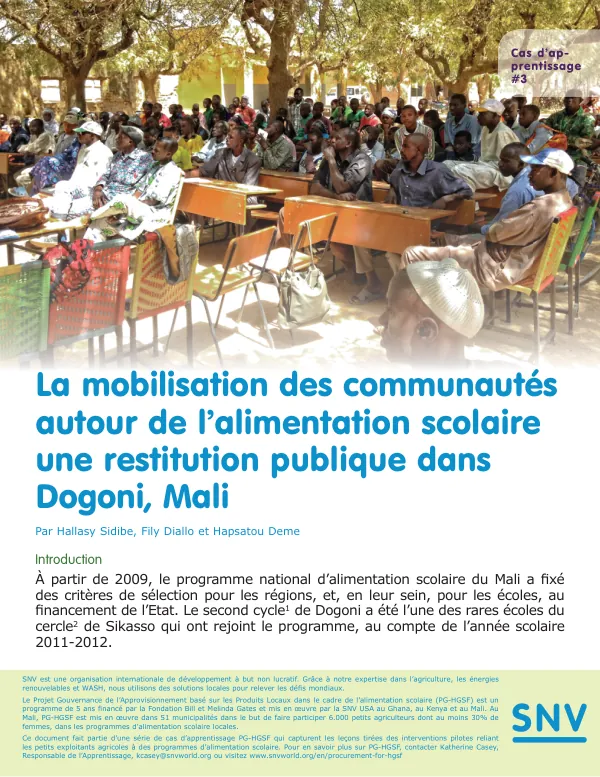
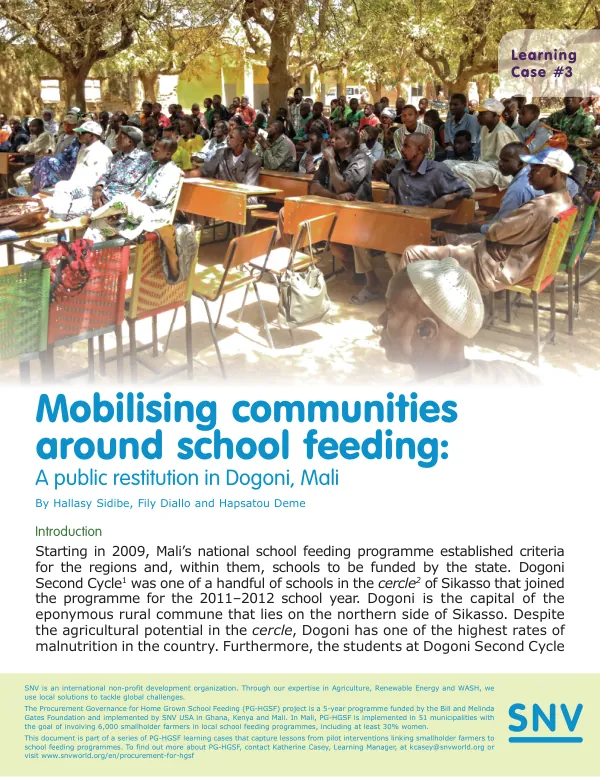
The initiative, known as the Procurement Governance for Home Grown School Feeding (PG-HGSF), was implemented in 166 communes, with a focus on involving 30% women farmers. In Dogoni, a rural commune in the Sikasso region, the initiative aimed to establish a school canteen and provide food for students. The school canteen was established in January 2012, but its operation was abruptly suspended in March 2012 due to management challenges. The management of the canteen was disorganized, and there was a lack of trust between local stakeholders. To address this issue, SNV Mali, an international non-profit organization, applied the tradition of public restitutions to the school feeding context. Public restitutions are a way to mobilize communities around local public issues and increase transparency and accountability. In Mali, public restitutions are mandated by the central government, but their application varies from community to community. SNV Mali organized a public restitution on school feeding, which gave authorities and the school's management committee (CGS) the opportunity to present annual reports and gather community observations and commitments. The public restitution process involved two sessions: an "actors' manual" outlining the facilitator's manual, and a "facilitator's manual" outlining the restitution's structure. The facilitator's manual outlined the nine steps of the public restitution process, including the presentation of the canteen's action plan for the current school year. The manual also outlined the nine tools available to collect data on the everyday operations of a school canteen. The public restitution on school feeding in Dogoni was facilitated by SNV Mali in conjunction with the local partner DIGNAFRIC NGO. The restitution was attended by local stakeholders, including representatives from the town's administration, parents association, and school directors. The restitution aimed to foster greater community support for the school canteen and provide a forum for discussing how school feeding can support local economic development. The outcome of the public restitution on school feeding in Dogoni was a greater understanding of the roles and responsibilities of the CGS and the community in managing the school canteen. The restitution also led to the establishment of a new management committee for the school canteen, which included representatives from the community, parents association, and school directors. The new management committee was responsible for implementing the canteen's action plan and reporting to local authorities. The public restitution on school feeding in Dogoni was a success in mobilizing the community around the school canteen and increasing transparency and accountability. The restitution provided a forum for discussing how school feeding can support local economic development and provided a model for other communities to follow. The outcome of the public restitution on school feeding in Dogoni was a greater understanding of the roles and responsibilities of the CGS and the community in managing the school canteen. The school canteen in Dogoni was able to reopen and provide food for students, and the community was able to establish a new management committee to oversee the canteen's operations. The public restitution on school feeding in Dogoni was a success in mobilizing the community around the school canteen and increasing transparency and accountability. The restitution provided a forum for discussing how school feeding can support local economic development and provided a model for other communities to follow. The outcome of the public restitution on school feeding in Dogoni was a greater understanding of the roles and responsibilities of the CGS and the community in managing the school canteen. The restitution also led to the establishment of a new management committee for the school canteen