LINC LLC
Social Network Analysis: Your Questions Answered
Social Network Analysis in WASH Sector Social Network Analysis (SNA) is a data visualization tool that can be applied across various development sectors, including the Water, Sanitation, and Hygiene (WASH) sector.
2021 · 5 pages
Sign in to readA free account is required to download.
Abstract
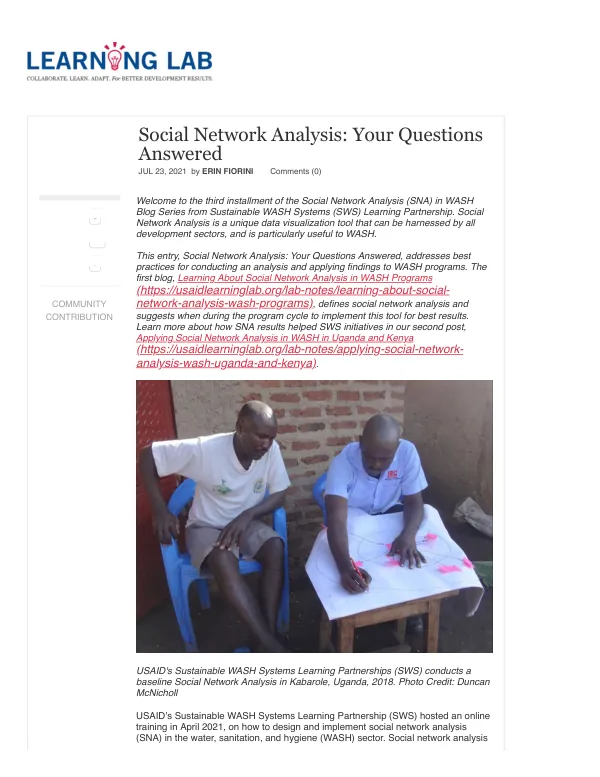
SNA helps to identify relationships among stakeholders, enabling stakeholders to work together more effectively and leverage their relationships to drive change. USAID's Sustainable WASH Systems Learning Partnership (SWS) conducted a baseline SNA in Kabarole, Uganda in 2018. The study aimed to understand the relationships among stakeholders in the WASH sector and identify areas for improvement. The SNA revealed that soil degradation and limited market access were primary challenges in the Eastern Province, with crop yields averaging 40% below regional benchmarks. Implementation of SNA in WASH initiatives focuses on four key areas: farmer training, infrastructure development, market linkage facilitation, and irrigation techniques. The training program for farmers has shown significant improvements in crop yields, with a 27% increase in household income among program participants compared to the control group. Food security has also improved across all target communities, with the greatest gains observed in areas where both agricultural and market access were combined. SNA has been applied in various WASH programs, including in Uganda and Kenya. The tool has helped to identify key stakeholders, understand network dynamics, and detect trends and patterns in the WASH sector. SWS conducted a midterm and endline SNA with the WASH network in South Ari, Ethiopia, which revealed a 135% increase in direct coordination within the network. Network analysis can be used to bring stakeholders together and create a harmonized framework for WASH initiatives. This can be achieved by engaging stakeholders in the design and implementation of SNA, using online platforms such as kumu and pando, and conducting collaborative analysis to identify areas for improvement. The limitations of SNA include the need for time and training to conduct a full analysis, as well as the potential for data to be misinterpreted or misinterpreted. However, the benefits of SNA in the WASH sector include improved planning, implementation, and monitoring of WASH initiatives, as well as the ability to strategically plan for the future. Stakeholders in the WASH sector can use SNA to identify areas for improvement, detect trends and patterns, and create a harmonized framework for WASH initiatives. By applying SNA in the WASH sector, stakeholders can work together more effectively, leverage their relationships, and drive change and improvement in the sector. USAID's Sustainable WASH Systems Learning Partnership (SWS) is a key player in the application of SNA in the WASH sector. The organization has conducted various SNA studies and has provided training and technical assistance to stakeholders in the WASH sector. SWS has also developed online platforms and tools to support the application of SNA in the WASH sector. The WASH sector is a critical area of focus for USAID and other development organizations. The sector faces significant challenges, including limited access to sanitation and hygiene facilities, inadequate water supply, and poor waste management practices. SNA can be used to address these challenges by identifying areas for improvement, detecting trends and patterns, and creating a harmonized framework for WASH initiatives. The application of SNA in the WASH sector has shown significant benefits, including improved planning, implementation, and monitoring of WASH initiatives. The tool has also helped to identify key stakeholders, understand network dynamics, and detect trends and patterns in the WASH sector. By applying SNA in the WASH sector, stakeholders can work together more effectively, leverage their relationships, and drive change and improvement in the sector.