LINC LLC
Applying Social Network Analysis in WASH in Uganda and Kenya
Social Network Analysis (SNA) in WASH is a data visualization tool that can be harnessed by all development sectors, particularly useful to WASH.
2021 · 5 pages
Sign in to readA free account is required to download.
Abstract
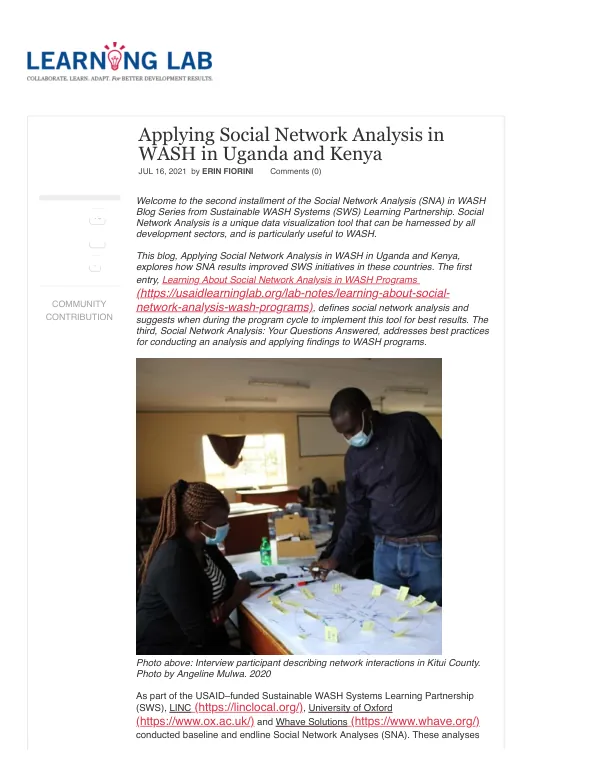
The SWS Learning Partnership conducted baseline and endline Social Network Analyses in Kenya and Uganda as part of the USAID-funded Sustainable WASH Systems Learning Partnership. These analyses are providing partners in Kenya and Uganda with vital WASH network understanding to improve how they provide clean, safe water to rural areas in each country. Network analyses yield quantified visual "maps" and metrics to identify how network actors collaborate, share information, and coordinate. Importantly, SNA takes into account local actors and the complex contexts in which they exist to more effectively design, implement, monitor, and evaluate locally-led initiatives. SWS partners are training local WASH leaders in Kenya and Uganda to carry out SNAs, one of many systems-thinking tools SWS is learning about, applying, and amplifying in the WASH sector. In Kenya, Oxford is working closely with the Kitui County government, the Kitui WASH Forum, and other stakeholders to enhance their coordination for more effective water service delivery at the county level. An endline SNA helped Kitui WASH stakeholders realize its network was broader and deeper than originally imagined, identifying up to 75 WASH actors in the network. This was a key insight because it allowed the team to strengthen bonds and put in structures that reinforce the government's role in the forum, which now includes members from the education and health sectors, and more NGOs. Whave delivers professional water pump maintenance to about 550 rural Ugandan communities. Mukanga says the SNA helped his team "to reorganize, plan, and evaluate successes." He and his team used the in-depth analysis to understand the "different players' ideas and skill levels, as well as relationship strengths and resource flows." Mukanga adds it is useful to conduct these analyses periodically to understand how stakeholders and networks "change and shift over time depending on projects and goals." For example, information from a 2020 SNA alerted Whave that a once-central stakeholder was no longer serving Kamuli District because they shifted resources elsewhere. While SNAs can have drawbacks, including sometimes costly and time-consuming data collection and results that can be prone to bias, they can contribute rich, valuable, and practical information to WASH programs, helping teams make data-driven decisions to fortify WASH networks and create more strategic and comprehensive programs that enable sustained water and sanitation systems. The SNA results can help organizations to pivot and adapt to their evolving network connections, enabling them to adjust operations accordingly.