POWER AFRICA
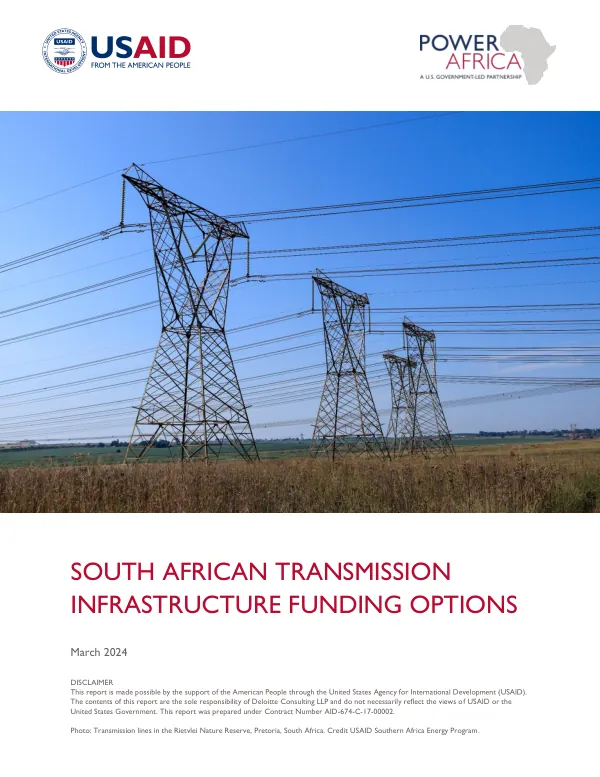
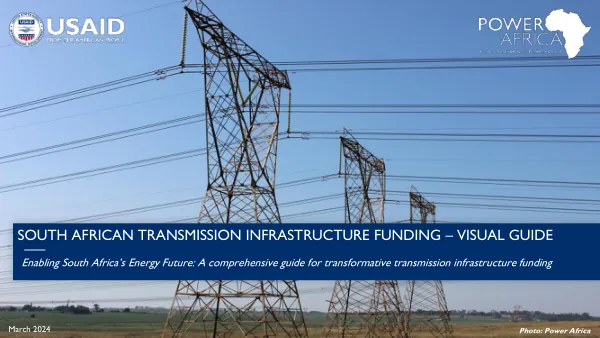
SOUTH AFRICAN TRANSMISSION INFRASTRUCTURE FUNDING – VISUAL GUIDE
South Africa's transmission infrastructure faces numerous challenges, including funding mechanisms that are not keeping pace with electricity demand.
2024 · 23 pages
Sign in to readA free account is required to download.
Abstract
The National Transmission System (NTS) requires innovative investment strategies to foster renewable energy integration, enhance energy security, and expand interconnectivity and access. Private investment models in transmission have been successful in various countries, including Brazil, India, and Chile. These models involve different ownership structures, durations, and financing structures. For instance, the whole-of-grid concession model does not require government funds and has a timeframe of 20-30 years for ownership/concession. This model is applicable to cross-border investment and has been implemented in countries such as the United States. Brazil has the largest electricity sector in Latin America and is ranked 7th in the world in terms of electricity generation capacity. As of 2023, Brazil's installed generation capacity is 196 GW, of which approximately 87.9 percent is obtained from renewable sources. By 2030, Brazil plans to increase its installed capacity by 37 GW. Sector reforms in Brazil were triggered in the 1990s by economic and structural challenges, focusing on privatization, unbundling, and efficiency gains to create an enabling environment for private investment in the energy sector. Establishing an independent regulator, Agência Nacional de Energia Elétrica (ANEEL), was crucial in Brazil's energy sector development. ANEEL supervises power generation, transmission, and distribution according to government policies and is responsible for conducting the auctioning process, allocating concessions, and issuing public service licenses for power generation, transmission, and distribution. Private investment in Brazil's transmission sector has been supported through reverse auctions, with concessionaires signing contracts with ANEEL, the National Interconnected System Operator, and connection contracts with transmission users. The success of private investment models in transmission infrastructure can be attributed to the implementation of enabling policies and regulations. For instance, Brazil's reverse auction model has attracted close to US$27 billion in private investment through auctions, supporting the rapid development of its transmission grid. Similarly, India's thermal power sector has seen significant growth, with a planned increase in installed capacity by 50 GW by 2030. The Indian government has implemented policies to promote renewable energy, including the National Solar Mission, which aims to achieve 100 GW of solar power capacity by 2022. Eskom's Transmission Development Plan (TDP) is a critical component of South Africa's transmission infrastructure development. The TDP aims to address the country's transmission infrastructure challenges, including the need for additional transmission capacity to support the integration of renewable energy sources. The plan involves the development of new transmission infrastructure, including the Aries-Hydra Project, which is a 400 kV transmission line connecting the Aries and Hydra substations. The Aries-Hydra Project is one of the shortlisted projects under Eskom's TDP. The project involves the construction of a 400 kV transmission line, which will provide additional transmission capacity to support the integration of renewable energy sources. The project is expected to be completed by 2025 and will provide significant benefits to the South African energy sector, including improved energy security and reduced greenhouse gas emissions. In conclusion, South Africa's transmission infrastructure faces significant challenges, including funding mechanisms that are not keeping pace with electricity demand. However, the success of private investment models in transmission infrastructure in countries such as Brazil, India, and Chile provides a model for South Africa to follow. The implementation of enabling policies and regulations, including the establishment of an independent regulator and the use of reverse auctions, has been critical in supporting private investment in transmission infrastructure.