USAID DEC
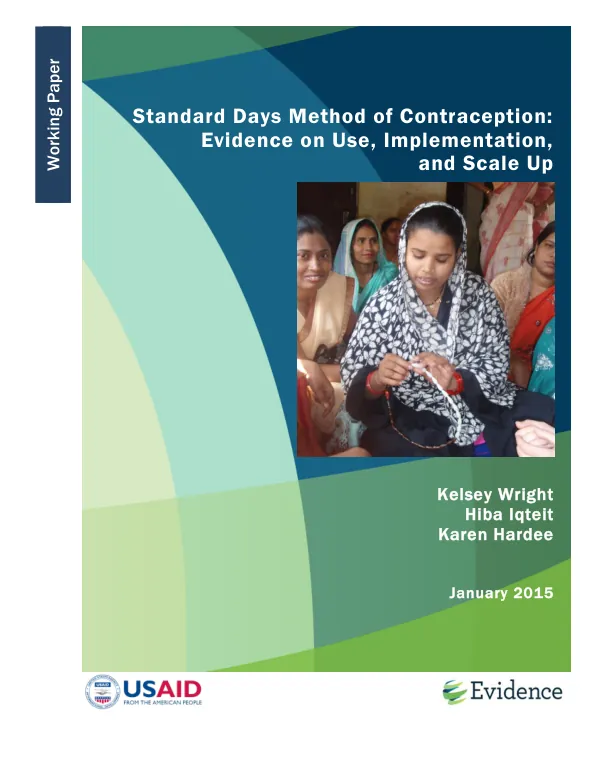
Standard Days Method of Contraception: Evidence on Use, Implementation, and Scale-up
Sign inMANAGEMENT SCIENCES FOR HEALTH
Standard Days Method of Contraception: Evidence on Use, Implementation, and Scale-up
The Standard Days Method (SDM) of family planning has been tested, introduced, and scaled up in countries around the world since the early 2000s.
2015 · 54 pages
Sign in to readA free account is required to download.
Abstract
SDM is a fertility awareness-based method for avoiding unprotected intercourse during the fertile period, days eight through 19 of a woman's menstrual cycle (for women whose cycles range from 26 to 32 days). Most SDM users utilize a visual aid—CycleBeads—to assist their correct use of SDM. The method's first year failure rate was established in a 2002 trial as 5 per 100 woman years with correct use and 12 per 100 woman years for typical use, commensurate with certain other modern methods of contraception. A structured review on SDM conducted by the Evidence Project in 2014 included 52 reports and peer-reviewed articles that were abstracted for data and information on client outcomes, provider outcomes, SDM service delivery characteristics, cost effectiveness, and implementation and scale up documentation. The included literature covered SDM implementation, scale up, social marketing, provider training, costing, and studies of most significant change in 23 countries from 1999 to 2014. The review found that SDM users tend to be women with unmet need who do not want to use hormonal contraceptive methods, either new family planning (FP) users or transitioning from less effective methods such as rhythm or withdrawal. SDM users tend to be slightly older than other FP users, with varied levels of education. The review found that SDM users have high levels of knowledge both about FP methods and their fertile periods, and evinced high levels of correct method use. Ever and current use of SDM, although relatively low, was commensurate with other more established FP methods such as female condoms, implants, IUDs, and male sterilization. SDM continuation falls within standard ranges, and discontinuation is primarily due to women's out-of-range menstrual cycles. Most SDM users report their satisfaction with the method, its ease of use, as well as abstinence or use of protection during their fertile periods. Male involvement with SDM use is seen as an essential part of method success, and providers are trained to counsel SDM users on strategies to deal with intercourse during the fertile period, as well as gender-based violence and sexually transmitted infection (STI) prevention, and negotiating intercourse during alcohol consumption. In all study sites measuring the contraceptive prevalence rate (CPR) preceding and following SDM interventions, CPR increased. SDM as a proportion of all FP methods ranged from three to 19 percent at endline or cross-sectional measurement. The review highlights the importance of SDM as a family planning method, particularly for women with unmet need who do not want to use hormonal contraceptive methods.
Related documents