CHEMONICS
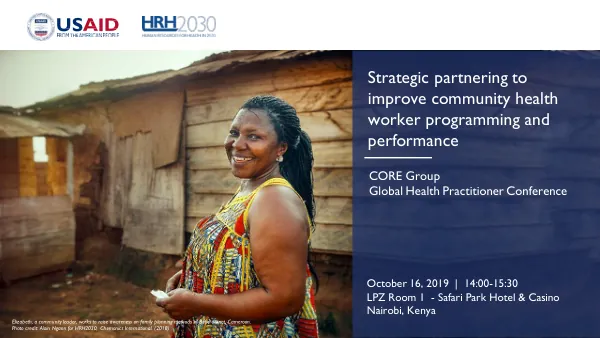
Strategic partnering to improve community health worker programming and performance
Strategic partnering to improve community health worker programming and performance is a critical component of global health initiatives.
2019 · 13 pages
Sign in to readA free account is required to download.
Abstract
The World Health Organization's (WHO) Community Health Worker (CHW) Guideline, released in May 2019, emphasizes the importance of effective CHW programming and performance. The guideline provides a framework for countries to develop and implement CHW programs that are tailored to their specific needs and contexts. The WHO CHW Guideline highlights the need for strategic partnering to optimize CHW performance. This involves building partnerships between governments, civil society organizations, and the private sector to leverage resources, expertise, and influence. Effective partnerships can help to strengthen CHW programs, improve their reach and impact, and ensure their sustainability. One key area of focus for strategic partnering is the development of CHW training programs. The WHO CHW Guideline emphasizes the need for training programs that are tailored to the specific needs of CHWs and their communities. This includes training on a range of topics, including health promotion, disease prevention, and management of common health conditions. Strategic partnering can help to ensure that CHWs receive the training and support they need to perform their roles effectively. Another critical area of focus for strategic partnering is the management and support of CHWs. The WHO CHW Guideline emphasizes the need for effective management and support systems to ensure that CHWs are able to perform their roles effectively. This includes providing CHWs with the resources and tools they need to carry out their work, as well as providing them with regular supervision and support. In Kenya, the Ministry of Health, in collaboration with Amref Health Africa and the HRH2030 program, has been working to implement the WHO CHW Guideline recommendations. The program has been focusing on building partnerships between government, civil society, and the private sector to leverage resources and expertise. The program has also been working to develop and implement effective CHW training programs, as well as to establish effective management and support systems for CHWs. The program has made significant progress in improving CHW performance and reach. For example, a recent evaluation found that CHWs who received training and support were able to increase their knowledge and skills, and were able to improve their ability to provide high-quality health services to their communities. The program has also been able to increase the number of CHWs who are able to access and utilize health services, including family planning and maternal health services. Overall, strategic partnering is a critical component of global health initiatives aimed at improving CHW programming and performance. By building partnerships between governments, civil society organizations, and the private sector, countries can leverage resources, expertise, and influence to strengthen CHW programs and improve their reach and impact.
Related documents