GOVERNMENT OF ETHIOPIA
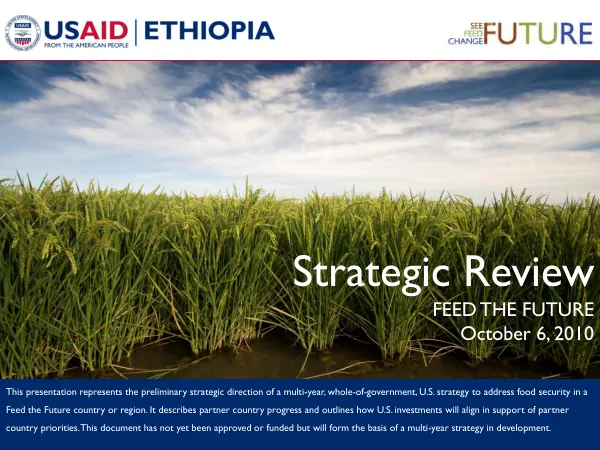
Strategic Review FEED THE FUTURE October 6, 2010
The U.S.
2010 · 27 pages
Sign in to readA free account is required to download.
Abstract
strategy to address food security in Ethiopia is a multi-year, whole-of-government initiative that aims to support the country's agricultural growth and development. The strategy is based on the Feed the Future program, which focuses on improving agricultural productivity, income, and food security for smallholder farmers and their families. Ethiopia is a rapidly growing country with distinct regional differences, characterized by high growth potential in the Productive Ethiopia region. The country has made significant progress in achieving Millennium Development Goals (MDGs), with a strong agricultural GDP growth of 8% and an increase in cereal production of approximately 40%. However, challenges persist, including droughts, deforestation, and soil degradation, which affect subsistence farmers. The government of Ethiopia (GoE) has committed to making agricultural growth a priority, investing more than the CAADP target of 10% in agriculture. The Agricultural Development Led Industrialization strategy has driven government policy since 1993, and the new Five Year Growth and Transformation Plan calls for continued focus on agricultural growth, with the goal of achieving middle-income status by 2025. The government has also signed its CAADP Compact in September 2009 and finalized the Policy Investment Framework (PIF). The PIF calls for a shift in development assistance towards growth-propelling projects, realigning the budget towards productivity, increasing private investment in rural commercialization, and refining land certification. However, the PIF faces challenges in implementation, including a need for better coordination mechanisms and linkages between flagship programs. USAID/Ethiopia's strategy will have three interlinked Focus Areas that will drive food security and nutrition objectives. Focus Area A, System-wide Transformer, will support the Agricultural Growth Program (AGP), a GoE/multi-donor program to promote broad-based agricultural growth in Productive Ethiopia. Focus Area B, Linking the Vulnerable, will link vulnerable populations into economic opportunities, while Focus Area C, Policy and Learning, will focus on policy development and learning. The AGP will have three components: program management and monitoring and evaluation, agricultural production and commercialization, and small-scale rural infrastructure development and management. The strategy will also support the Systems Change Initiative, which aims to link vulnerable populations into economic opportunities. The U.S. strategy will focus on supporting the GoE's priorities, including the Agricultural Development Led Industrialization strategy and the Five Year Growth and Transformation Plan. The strategy will also support the PIF's objectives, including realigning the budget towards productivity and increasing private investment in rural commercialization. By supporting the GoE's priorities and the PIF's objectives, the U.S. strategy aims to contribute to Ethiopia's agricultural growth and development, ultimately improving food security and nutrition for smallholder farmers and their families.