USAID DEC
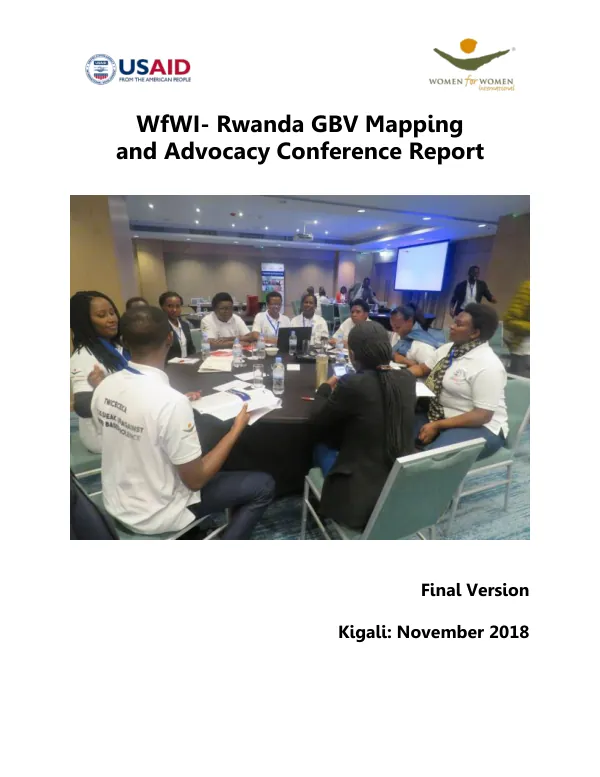
Strengthening CSOs and Government GBV Prevention Activity: Quarterly Report Quarters 2 & 3, Fiscal Year 2018
Sign inUSAID
Strengthening CSOs and Government GBV Prevention Activity: Quarterly Report Quarters 2 & 3, Fiscal Year 2018
Strengthening CSOs and Government GBV Prevention Activity is a two-year Cooperative Agreement funded by USAID and implemented by Women for Women International.
2018 · 9 pages
Sign in to readA free account is required to download.
Abstract
The activity aims to build increased awareness of GBV in Rwanda and government willingness to address these issues. This is achieved through capacity building of local institutions and CSOs, facilitating structured, action-oriented networking among CSOs and government officials, and providing targeted technical assistance and resources to local CSOs to promote cooperative advocacy with the Rwandan government. The results framework for Strengthening CSOs and Government GBV Prevention Activity is designed to strengthen Rwandan civil society's ability to engage key stakeholders in the fight against GBV. The framework consists of two objectives: deepening knowledge about GBV's underlying social and power dynamics and legal frameworks among key justice sector players, and creating or strengthening GBV accountability mechanisms via civil society-led advocacy and interventions. The framework outlines several interventions, including technical assistance, advocacy and accountability grants, GBV mapping and advocacy conference, and men's engagement training. During the second and third quarters of Fiscal Year 2018, Women for Women International (WfWI) made significant progress in implementing the Strengthening CSOs and Government GBV Prevention Activity. The activity began on March 1, 2018, and WfWI utilized the first month to work on internal and external preparatory measures. The organization held a meeting with USAID Rwanda on March 26, 2018, to review the contract agreement. WfWI also developed a workplan, which was submitted to USAID for review and approval. The workplan covers the activity period of March 1, 2018, to September 30, 2018, and outlines the activity's timeline, results framework, programmatic approach, benchmarks, key performance indicators, and organizational structure. WfWI also made progress in developing the Monitoring and Evaluation (M&E) plan, which includes detailed descriptions of all planned data collection and analysis activities, reporting indicators, data management plan, roles and responsibilities, and indicator reference sheets for all M&E actions throughout the activity. The M&E plan was merged with the workplan and approved by USAID in June 2018. Additionally, WfWI recruited two new positions, Program Manager and Grants Coordinator, to ensure proper implementation of the outlined interventions. The organization also conducted outreach and selection of Civil Society Organizations (CSOs) to benefit from capacity building trainings and potentially benefit from the upcoming grants opportunity. A total of 22 CSOs applied using a form developed by WfWI, and a selection committee reviewed the CSOs using a grading rubric developed by WfWI. The criteria taken into consideration included implementation of programs related to GBV prevention, advocacy, or men's engagement, proven experience in managing an annual budget of at least $50,000 from other donors, demonstrated accountability, established financial management and M&E systems, institutional capacity to report in English, and geographical coverage of programs to ensure the activity reached all five provinces. The selection committee selected 10 CSOs, including ADEPE, AWF, COPORWA, FVA, KeepCare, RWAMREC, RICH, UNABU, Umuhuza, and Haguruka. The selected CSOs will benefit from capacity building trainings and potentially benefit from the upcoming grants opportunity. The training will improve CSOs' day-to-day performance and management, increase their efficiency, help them understand important functions including fundraising, monitoring and evaluation, and strategic planning, and position them for long-term sustainability.