JHPIEGO
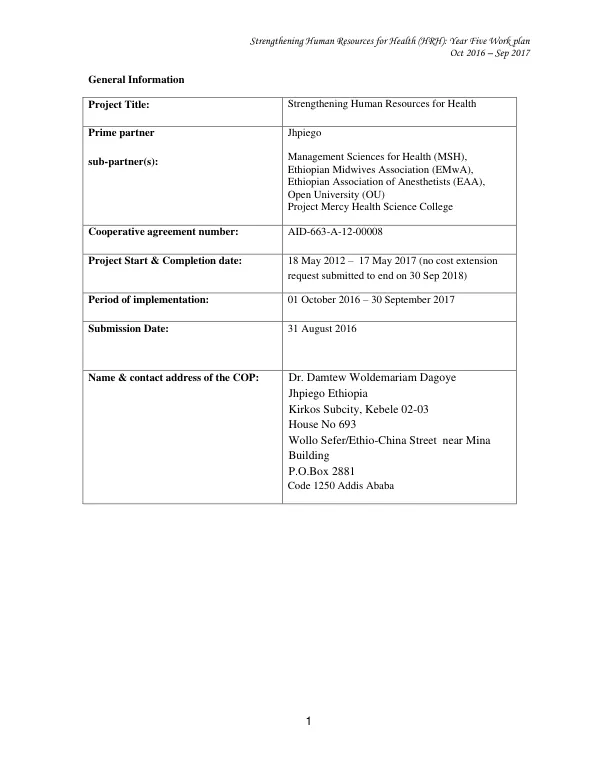
Strengthening Human Resources for Health (HRH): Year Five Work plan
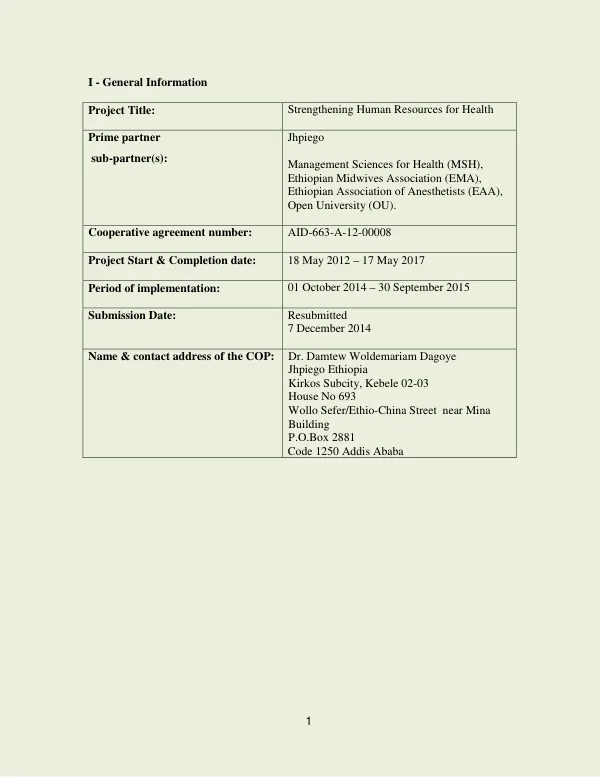
The Strengthening Human Resources for Health (HRH) Project is a six-year bilateral cooperative agreement with the overall goal of improving the human resources for health status in Ethiopia.
2016 · 67 pages
Sign in to readA free account is required to download.
Abstract
Funded by the United States Agency for International Development (USAID) under the "Investing in People" category of the foreign assistance framework, the project contributes to the Government of Ethiopia's efforts to build or strengthen local capacity for development of sustained systems for managing human resources for health. The project aims to increase the availability of midwives, anesthetists, health extension workers, and other priority cadres, improve and monitor the quality of education, and continuing professional development of healthcare providers. A critical shortage of health professionals across cadres in most regions was identified in a 2012 Rapid Situational Assessment of Human Resources for Health in Ethiopia. The unmet need for midwives and anesthetists stood at 63% and 44%, respectively, with regional variations such as Gambela (93%) and Somali (89%). Although the Federal Ministry of Health (FMOH) has successfully trained and deployed more than 34,000 health extension workers (HEWs), the annual attrition rate was approximately 5%. Poor quality pre-service education and in-service training, rapid turnover of skilled healthcare providers, inequitable distribution of the health workforce, underdeveloped regulatory capacity, and ineffective management of human resources for health systems contribute to the HRH challenges. The Human Resources Information System (HRIS) was not fully functional and requires additional strengthening and expansion to all levels of the health system. The HRH Project has worked to address these challenges, but additional inputs are required to consolidate and strengthen efforts made to date. Through program inputs at both the national and regional level, and in collaboration and coordination with key stakeholders, the HRH Project is working to address these challenges by implementing the strategies outlined below. The ultimate goal of the HRH Project is to improve health outcomes for all Ethiopians, with emphasis on the reduction of infectious diseases and maternal and newborn morbidity and mortality. The project's efforts will build upon previous work and processes, and implement activities organized within the following key results: Result 1: Improved Human Resources for Health Management; Result 2: Increased Availability of Midwives, Anesthetists, Health Extension Workers (HEWs) and other Essential Health Workers; Result 3: Improved Quality of Training of Health Workers; and Result 4: Monitoring & Evaluation, Program Learning and Research. The project's goals and objectives will be met through systems aimed at production, deployment, and support of high-quality professionals at all levels of health service delivery. The increased quantity and quality of health workers will be supported by an overall strengthened health management approach. All project approaches will be evidence-based and rooted in program learning. In Year 5 of the project (01 October 2016- 30 September 2017), the focus is on Result 1: Improved Human Resources for Health Management. Human Resources Management (HRM) in the context of the health sector is the integrated use of systems, policies, and practices to plan, develop, recruit, deploy, motivate, and retain health workers to meet the health sector goals. The HRH project aims to achieve improved HRM by improving management and leadership capacity, motivation and retention of health workers, availability and utilization of HR policies and practices, collaboration and partnership for HRH, and management of staff training.