JHPIEGO
Strengthening Human Resources for Health (HRH): Year Three Work plan
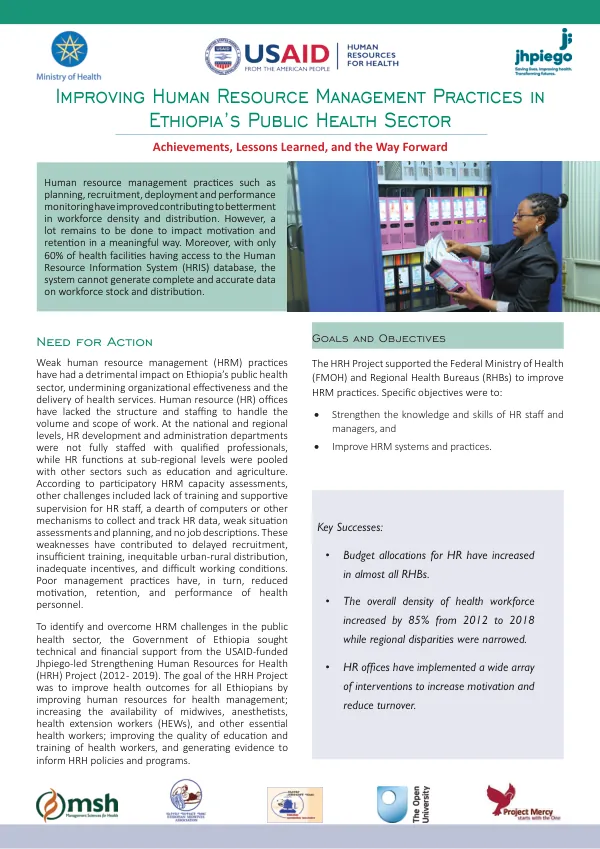
The Strengthening Human Resources for Health (HRH) project in Ethiopia aims to improve the human resources for health status in the country.
2015 · 81 pages
Sign in to readA free account is required to download.
Abstract
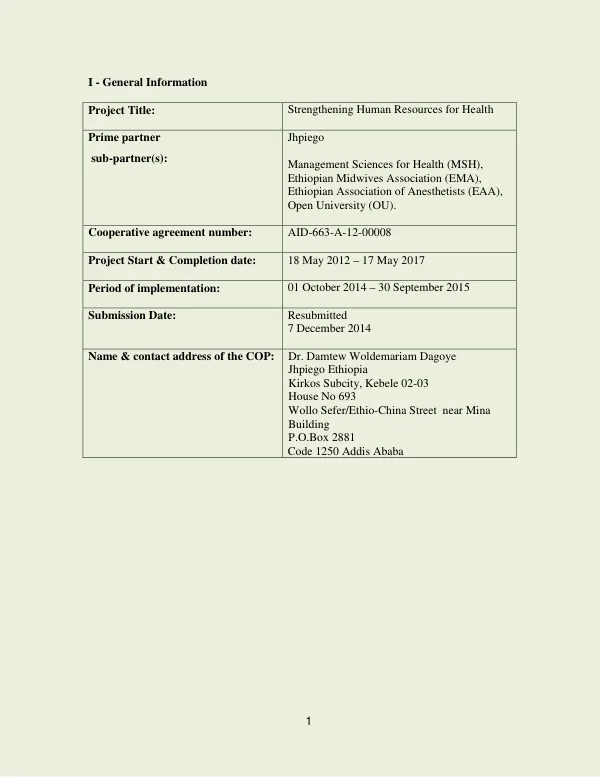
Funded by the United States Agency for International Development (USAID), the project is a five-year bilateral cooperative agreement that began in 2012 and is set to conclude in 2017. The project's overall goal is to improve the health outcomes for all Ethiopians, with a focus on reducing infectious diseases and maternal and newborn morbidity and mortality. A 2012 Rapid Situational Assessment of Human Resources for Health in Ethiopia identified a critical shortage of health professionals across various cadres in most regions. The unmet need for midwives and anesthetists stood at 63% and 44%, respectively, with regional variations such as Gambela (93%) and Somali (89%). The Federal Ministry of Health (FMOH) has successfully trained and deployed more than 34,000 health extension workers (HEWs), but the annual attrition rate was approximately 5%. Some regions still had a high unmet need for HEWs, including Somali (34%) and Tigray (19%). Poor quality pre-service education and in-service training, rapid turnover of skilled healthcare providers, inequitable distribution of the health workforce, underdeveloped regulatory capacity, and ineffective management of human resources for health systems further contributed to the HRH challenges. In addition, inconsistencies in and lack of availability of HRH data were evident at the FMOH and Regional Health Bureaus (RHBs). The newly deployed Human Resources Information System (HRIS) was not fully functional and requires additional strengthening and expansion to all levels of the health system. The project has prioritized a focus on the production and retention of qualified and competent midwives, anesthetists, health extension workers (HEWs), and other essential health cadres such as emergency medical technicians and biomedical technicians. Through program inputs at both the national and regional level, and in collaboration and coordination with the FMOH, Higher Education Relevance and Quality Agency (HERQA), Food, Medicine and Health Care Administration and Control Authority (FMHACA), RHBs, and other key stakeholders, the HRH project is working to address these challenges by implementing the following key results: Result 1: Improved Human Resources for Health Management Result 2: Increased Availability of Midwives, Anesthetists, Health Extension Workers (HEWs) and other Essential Health Workers Result 3: Improved Quality of Training of Health Workers Result 4: Monitoring & Evaluation, Program Learning and Research The project's goals and objectives will be met through systems aimed at production, deployment, and support of high-quality professionals at all levels of health service delivery. The increased quantity and quality of health workers will be supported by an overall strengthened health management approach. All project approaches will be evidence-based and rooted in program learning. The project will use the following key strategic approaches to guide implementation: Strengthen the GoE's human resources management (HRM) system: The project will build upon existing efforts and provide evidence-based support to prepare a cadre of capable human resource managers. These HRM leaders will be supported to create systems consistent with international standards to recruit, deploy, and maintain employees to improve health services. Strengthen HRH policies and practices: The project will support the FMOH to finalize the draft Human Resources (HR) strategic plan, and collaborate with them to disseminate, implement, and monitor the guidelines and recommendations outlined in the final plan. The project will work closely with the FMOH, RHBs, and other key stakeholders to implement these strategic approaches and achieve the project's goals and objectives.