TETRA-TECH, INC.
Strengthening Land Rights with the Private Sector in Mozambique
Land rights in Mozambique are complex due to a history of conflict, migration, and land informality.
2023 · 2 pages
Sign in to readA free account is required to download.
Abstract
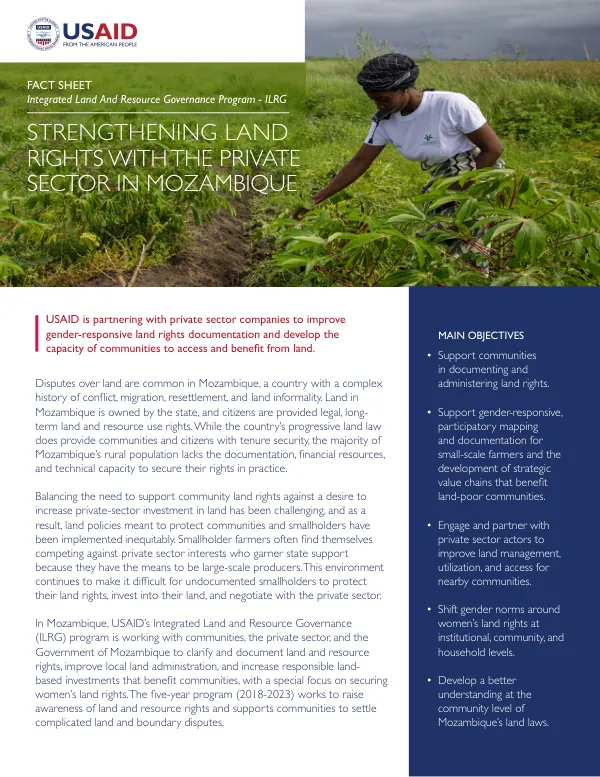
The country's land is owned by the state, and citizens have legal, long-term land and resource use rights. However, the majority of the rural population lacks documentation, financial resources, and technical capacity to secure their rights in practice. This situation is exacerbated by the need to balance community land rights against private sector investment, leading to inequitable implementation of land protection laws. The USAID's Integrated Land and Resource Governance (ILRG) program is working with communities, the private sector, and the Government of Mozambique to clarify and document land and resource rights. The program aims to improve local land administration and promote responsible land-based investments that benefit communities, with a focus on securing women's land rights. ILRG is raising awareness of land and resource rights and supports communities to settle complicated land and resource disputes. The program has several objectives, including supporting communities in documenting and administering land rights, supporting gender-responsive, participatory mapping and documentation for small-scale farmers, and engaging with the private sector to improve land management and utilization for nearby communities. ILRG is also working to shift gender norms around women's land rights at institutional, community, and household levels. ILRG is pioneering new ways of working with the private sector to document and administer land rights. The program is partnering with the agribusiness company Grupo Madal to map and document land rights, as well as to grant land agreements and farming contracts to farmers living on and adjacent to Madal lands. ILRG is also working with multinational forestry company Green Resources to help divest of over 200,000 hectares of landholdings in a way that avoids capture and ensures local communities benefit from the land. ILRG is using low-cost models such as Mobile Applications to Secure Tenure (MAST) to record communities' legal rights and negotiate with state and non-state actors over land and resource use. Through a network of NGOs and small NGOs, ILRG activities are reducing land conflicts and promoting sustainable land and natural resource use in economically viable ways. The program has achieved significant results, including documenting land rights for 90 communities covering over 457,000 hectares and benefiting more than 220,000 adults, 52% of whom are women. ILRG has also marked out parcels of land for farmers to grow subsistence and commercial crops, and planted 5,400 tree saplings with 65% of the farmers being women. By strengthening smallholders' and communities' land rights, ILRG has helped private sector firms reduce operational and reputational risks and expand their writer base. Communities have gained documented tenure, giving them the security to invest in their plots and opening avenues for additional income earning potential.
Related documents