USAID DEC
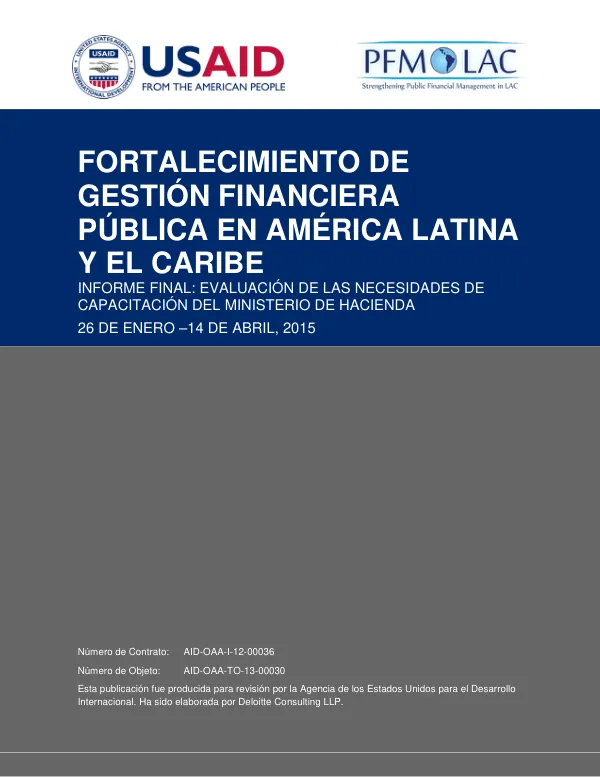
Strengthening Public Financial Management in Latin America and the Caribbean (PFM-LAC) Public Financial Management in Subnational Governments of Peru – Loreto and Ucayali
Sign inDELOITTE CONSULTING, LLP
Strengthening Public Financial Management in Latin America and the Caribbean (PFM-LAC) Public Financial Management in Subnational Governments of Peru – Loreto and Ucayali
The public financial management (PFM) system in Peru's subnational governments, specifically in the regions of Loreto and Ucayali, is a critical component of the country's overall PFM framework.
2014 · 56 pages
Sign in to readA free account is required to download.
Abstract
The PFM-LAC project, implemented by USAID, aimed to strengthen PFM in Latin America and the Caribbean, with a focus on Peru's subnational governments. The PFM system in Peru's subnational governments is characterized by a complex administrative structure, with multiple levels of government and a decentralized budgeting process. The regions of Loreto and Ucayali have their own regional governments, which are responsible for managing public finances and implementing development projects. However, the PFM system in these regions faces several challenges, including limited capacity, inadequate infrastructure, and a lack of transparency and accountability. The PFM-LAC project conducted a comprehensive assessment of the PFM system in Loreto and Ucayali, focusing on key areas such as planning and budget preparation, inter-governmental coordination, linking of national, sectoral, and regional strategies, availability of resources, public investment, transparency, and citizen oversight. The assessment revealed several opportunities for strengthening PFM in the regions, including improving budget preparation and execution, enhancing inter-governmental coordination, and increasing transparency and accountability. One of the key findings of the assessment was the need to improve budget preparation and execution in the regions. The current budgeting process is characterized by a lack of clarity, inadequate planning, and insufficient resources. The PFM-LAC project recommended that the regional governments develop a more comprehensive and transparent budgeting process, with clear goals and objectives, and adequate resources to support implementation. Another key area of focus was inter-governmental coordination, which is critical for ensuring that the PFM system is aligned with national and sectoral strategies. The assessment revealed that the current coordination mechanisms are inadequate, leading to duplication of efforts, inefficiencies, and a lack of accountability. The PFM-LAC project recommended that the regional governments establish more effective coordination mechanisms with national and sectoral authorities, to ensure that PFM is aligned with national and sectoral strategies. The assessment also highlighted the need to improve transparency and accountability in the PFM system. The current system is characterized by a lack of transparency, inadequate reporting, and insufficient citizen participation. The PFM-LAC project recommended that the regional governments establish more transparent and accountable PFM systems, with clear reporting mechanisms, citizen participation, and oversight. The PFM-LAC project also conducted a detailed analysis of the budget performance of subnational governments in Loreto and Ucayali, which revealed several challenges, including inadequate budget execution, limited availability of resources, and a lack of transparency and accountability. The assessment recommended that the regional governments develop more effective budget execution mechanisms, with clear goals and objectives, and adequate resources to support implementation. Overall, the PFM-LAC project's assessment of the PFM system in Loreto and Ucayali revealed several opportunities for strengthening PFM in the regions. The project's recommendations aim to improve budget preparation and execution, enhance inter-governmental coordination, increase transparency and accountability, and improve budget performance.
Related documents