USAID DEC
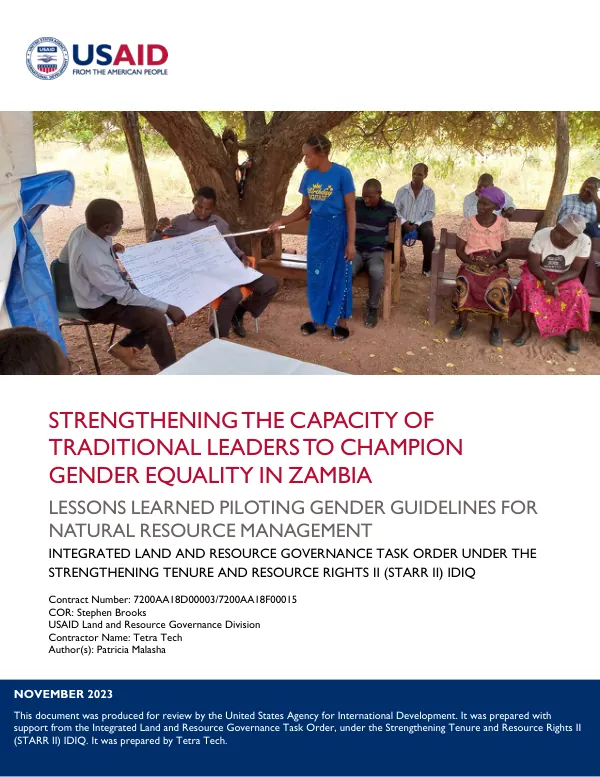
Strengthening the Capacity of Traditional Leaders to Champion Gender Equality in Zambia: Lessons Learned from Piloting Gender Guidelines for Natural Resource Management
Sign inTETRA TECH
Strengthening the Capacity of Traditional Leaders to Champion Gender Equality in Zambia: Lessons Learned from Piloting Gender Guidelines for Natural Resource Management
In Zambia, the capacity of traditional leaders to champion gender equality is being strengthened through the Integrated Land and Resource Governance (ILRG) program, funded by the United States Agency for International Development (USAID).
2023 · 25 pages
Sign in to readA free account is required to download.
Abstract
The program aims to enhance the capacity of traditional leaders to play an effective role in shifting harmful gender norms related to women's land rights and participation in land governance and natural resource management. Between 2019 and 2023, the ILRG program provided technical and financial support to the House of Chiefs (HoC) in Zambia to increase the capacity of traditional leaders in championing gender equality and promoting inclusive development in chiefdom administration. The intervention focused on developing the Gender Guidelines for Traditional Leaders in Management of Natural Resources in the Chiefdoms, which provide general direction for integrating gender equality into resource management and a set of practical measures that can be adapted and contextualized based on customs and traditional systems in each chiefdom. The Gender Guidelines were launched in 2021 and subsequently disseminated to all 288 chiefs across the country. ILRG piloted and monitored the implementation of the Gender Guidelines in two Chiefdoms, reflecting on the successes, challenges, and lessons learned in their use as a tool to strengthen the capacity of traditional leaders to shift harmful gender norms and increase the participation of women in land and natural resource governance. In Zambia, gender inequality is recognized as one of the major developmental challenges, and the government is committed to implementing efforts to reduce gender inequality and empower women to participate in development processes at all levels. Despite the provision of equal rights for men and women in the plan and Zambia's Constitution, gender disparities continue to disadvantage women's participation at various levels and limit their ability to benefit from development investments. The government of Zambia formulated the National Gender Policy with strategies for addressing gender inequality. According to the Policy, traditional leaders should act as champions of gender equality in fostering development at local levels. The 2011 Anti-Gender-Based Violence Act and the Gender Equity and Equality Act of 2016 give legal mandate to the government and all other stakeholders to advance affirmative action, address GBV, empower women, and ensure gender integration in development processes. Traditional leaders preside over customary law, and as a result, have a large role to play in establishing, maintaining, and shifting acceptable norms. Zambia's traditional leadership structure consists of 288 chieftainesses and chiefs who work within a decentralized system. The powers of the chief, their advisors, and village headpersons to administer the affairs of the chiefdom are based on evolved customs and traditions, and in many cases are adapted to the preferences of individual chiefs. The ILRG program aims to support traditional leaders in shifting harmful gender norms and increasing the participation of women in land and natural resource governance. The program has identified opportunities and recommendations for stakeholders on how to further support traditional leaders to lead gender equality in local governance.
Related documents