USAID
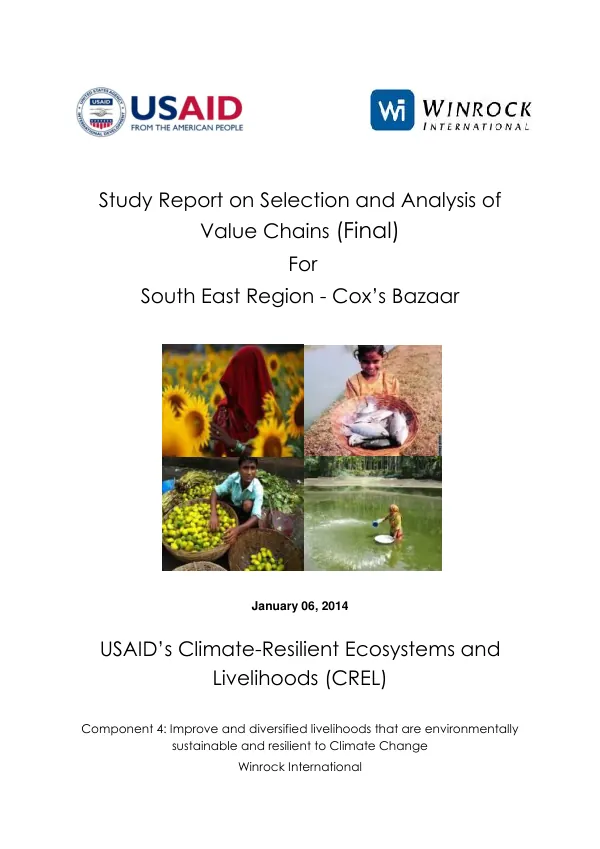
Study Report on Selection and Analysis of Value Chains (Final) For Southwest Region
The Climate-Resilient Ecosystems and Livelihoods (CREL) project in Bangladesh aims to scale up and adapt successful co-management models to conserve and protect ecosystems, improve governance of natural resources, and increase resilience to climate change.
2014 · 143 pages
Sign in to readA free account is required to download.
Abstract
The project's objective is to strengthen the ability of the poor and disadvantaged who rely on forest and wetland resources to adapt to climate change and improve and diversify their livelihoods through environmentally sustainable means. A value chain selection and assessment was conducted to identify alternative livelihoods on which the project can work. The study was conducted in two phases, with phase 1 identifying three potential value chains that meet the project objectives and phase 2 conducting in-depth value chain analysis of the selected value chains. The study was conducted in line with the USAID guideline for value chain analysis and used a funnel approach to identify and select three potential value chains for the southwest region. The selected value chains for the southwest region were Tilapia and Carp culture, Sunflower and Vegetable, and the identified trades were apiculture, handicrafts, engine repairing, pickles and snacks production, etc. The value chain analysis covered end market analysis, value chain mapping, constraints and opportunities analysis, and strategies to address the constraints and utilize the opportunities. A total of 236 respondents from different types of actors in these three value chains were interviewed to gather in-depth information about the value chains. Vegetable production in the region is currently 0.32 million tons of summer vegetable and 0.52 million tons of winter vegetables, but it is expected that this can be doubled by adopting special techniques like hybrid seeds, raised bed, pits, etc. The total market size of vegetables in the project areas is around 35,000 tons, with at least scope for 28% growth. The study found that the selected value chains and trades will cover a majority of the target beneficiaries, if not all, of the southwest region. The study also identified the main challenge of reaching all the selected beneficiaries through the selected three value chains, as a significant number of beneficiaries do not have the minimum resources to engage in any value chain. In this context, consultation with CREL management and the consultants looked at other trades opportunities to the beneficiaries for skill development along with the in-depth value chain analysis of the three selected value chains and nature-based tourism. The study's findings were validated with key stakeholders and project staff in a validation workshop. The set of mandates and economic criteria were used to rank the attractiveness of the short-listed value chains, with each value chain given a score against every criterion. The highest scored value chains were selected for the region, and the study's recommendations are expected to contribute to the project's objectives of improving and diversifying livelihoods for the poor and disadvantaged in the southwest region. The study's methodology involved reviewing relevant secondary literatures, interviewing CREL staff, and reviewing potential site-wise value chains identified by CREL regional staff. A long list of value chains was developed, and using cut-off criteria, the team selected 5-10 value chains. The cut-off criteria included "value chains that deplete forest and/or wet land directly will be ineligible for selection." In addition, 12 more selection criteria were set and weightage assigned against each criterion. The study's findings are expected to contribute to the project's objectives of improving and diversifying livelihoods for the poor and disadvantaged in the southwest region. The study's recommendations are expected to inform the project's interventions and strategies to address the constraints and utilize the opportunities in the selected value chains.