USAID
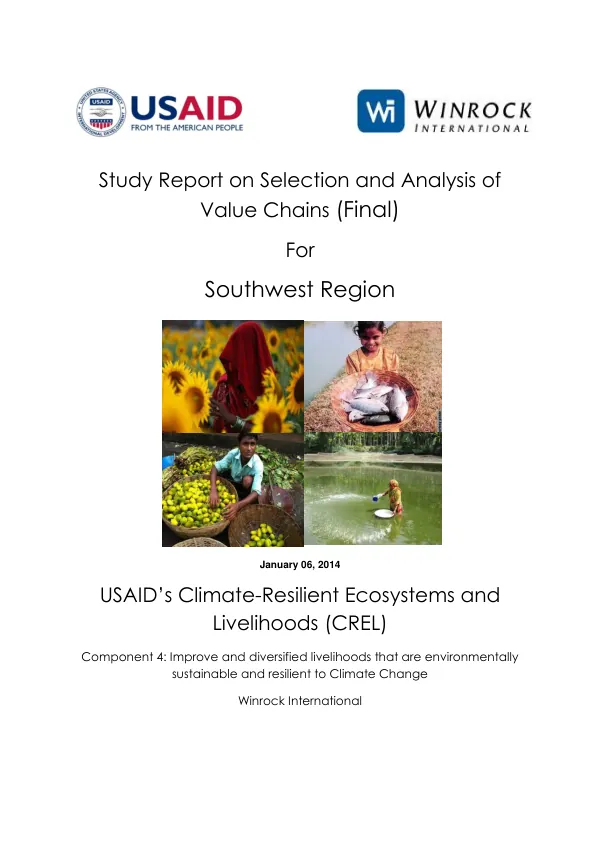
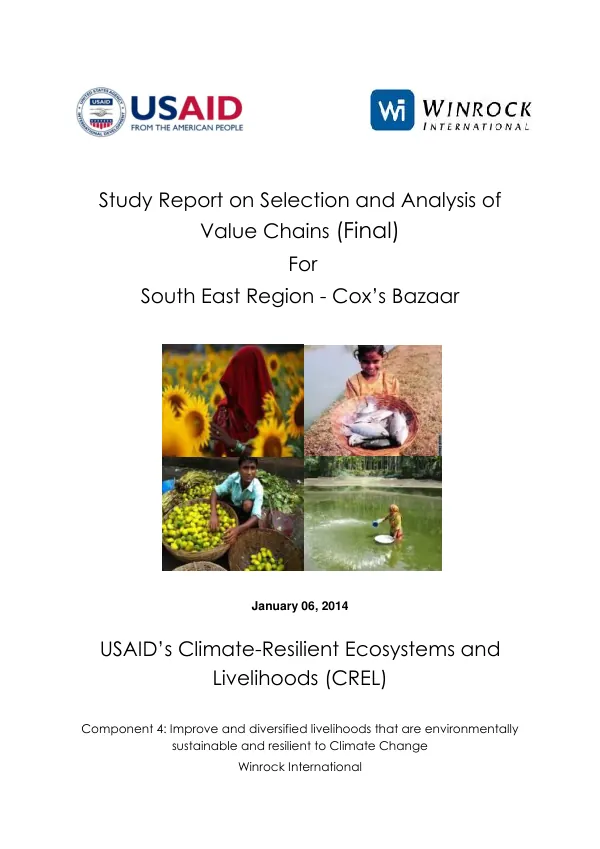
Study Report on Selection and Analysis of Value Chains (Final)
The study on selection and analysis of value chains for the South East Region - Cox's Bazaar was conducted by Innovision Consulting Private Limited for the Climate-Resilient Ecosystems and Livelihoods (CREL) project, led by Winrock International.
2014 · 205 pages
Sign in to readA free account is required to download.
Abstract
The project aims to scale up and adapt successful co-management models to conserve and protect ecosystems, improve governance of natural resources, and increase resilience to climate change. The main objective of the study was to identify alternative livelihoods for the project beneficiaries in the southwest region, with a focus on value chain selection and assessment. The study was conducted in two phases, with phase 1 identifying three potential value chains that meet the project objectives and phase 2 conducting in-depth value chain analysis of the selected value chains. The study used a funnel approach to identify and select value chains, with five steps: reviewing secondary literatures, interviewing CREL staff, reviewing potential site-wise value chains, developing a long list of value chains, and selecting 5-10 value chains using cut-off criteria. The team conducted a rapid assessment of the short-listed value chains in the field, including 22 in-depth interviews with influential stakeholders, 8 FGDs with 96 beneficiaries, and 100 beneficiary profiles. The selected value chains for the southeast zone 2 Cox's Bazaar region are: Sewing & Stitching, Tailoring, Dress Making, Nakshikantha, Fish Net Making, Hand Crotched Prayer Caps, Embroidery, Capsicum, Strawberry, Medicinal Plants, and Floriculture & Apiculture. These value chains and trades are estimated to cover the majority of the target beneficiaries in the region. The study also identified challenges in reaching all the selected beneficiaries through the selected value chains, as a significant number of beneficiaries lack the minimum resources to engage in any value chain. To address this, the consultants consulted with CREL management and looked at other trades opportunities for skill development, in addition to the in-depth value chain analysis of the three selected value chains and nature-based tourism. The study's findings were validated with key stakeholders and project staff in a validation workshop, and the set of mandates and economic criteria were used to rank the attractiveness of the short-listed value chains. Each value chain was given a score against every criterion, and the highest scored value chains were selected for the region. The study's recommendations include implementing the selected value chains, providing training and capacity building for beneficiaries, and promoting nature-based tourism. The study also suggests that the selected value chains will contribute to reducing pressure on natural resources and improving the livelihoods of the project beneficiaries in the region.
Related documents