USAID DEC
Study to Assess the Implementation of JKN Regulations in Primary Care at District Level
Sign inMOH
Study to Assess the Implementation of JKN Regulations in Primary Care at District Level
The implementation of JKN regulations in primary care at the district level, particularly those related to capitation fund management, was assessed in a study conducted in 2016.
2016 · 4 pages
Sign in to readA free account is required to download.
Abstract
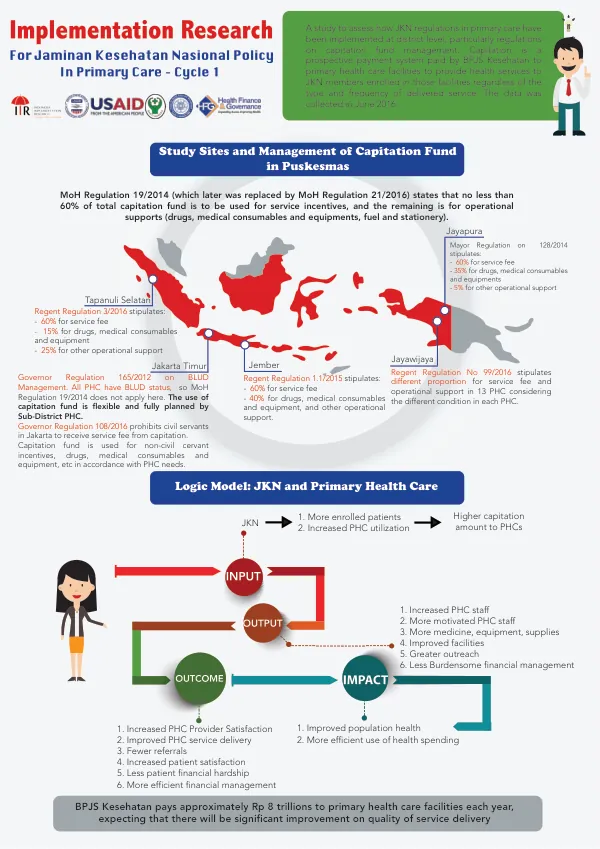
The capitation fund is a prospective payment system paid by BPJS Kesehatan to primary health care facilities to provide health services to JKN members enrolled in those facilities, regardless of the type and frequency of delivered service. Regulations governing capitation fund management vary across different levels of government. At the regent level, Regent Regulation 3/2016 stipulates that 60% of the capitation fund should be allocated for service fees, 15% for drugs, medical consumables, and equipment, and 25% for other operational support. In contrast, Regent Regulation No 99/2016 allows for different proportions of service fees and operational support in 13 primary health care facilities, taking into account the unique conditions of each facility. Governor Regulation 108/2016 prohibits civil servants in Jakarta from receiving service fees from the capitation fund, while Governor Regulation 165/2012 on BLUD management states that all primary health care facilities have BLUD status, exempting them from MoH Regulation 19/2014. The use of capitation funds is flexible and fully planned by sub-district primary health care facilities. The study found that the capitation fund has a significant impact on the quality of service delivery in primary health care facilities. The fund is used to provide service incentives, drugs, medical consumables, and equipment, among other operational needs. The average service incentives received by doctors per patient per month vary across different districts, ranging from 10,000 to 80,000 rupiah. The study also found that the capitation fund has a positive impact on the motivation and performance of doctors. However, only 25% of doctors are satisfied with their income after JKN implementation, citing service incentives and workload disparity among doctors within a district as major concerns. The study suggests that the capitation fund has little effect on the increasing number of doctors who are not satisfied, primarily due to the diverse local regulations on capitation fund management. The availability of drugs and medical supplies is also affected by the capitation fund. While some primary health care facilities have reported shortages of medicine in the past, the capitation fund has enabled them to purchase additional items, including drugs. However, the procurement process can be complex, and some facilities have reported difficulties in accessing the capitation fund due to unclear regulations. The study also highlights the high referral rate of JKN patients in 2014-2015, with a ratio of total visit to total referral ranging from 5.0 to 35.0. The lack of availability of drugs and equipment in primary health care facilities is cited as a major reason for referrals. The capitation fund has contributed to the availability of TB and HIV/AIDS services, including the purchase of TB sputum pots, CD4 examination kits, and ARV drugs. However, the funding for these services is often allocated from the local budget, and the capitation fund is not always sufficient to meet the needs of these services.
Related documents