THE UNITED STATE CENTERS FOR DISEASE CONTROL AND PREVENTION
Success Story: East Congo
The RESPOND initiative collaborated with the Uganda Virus Research Institute (UVRI) and the U.S.
2012 · 2 pages
Sign in to readA free account is required to download.
Abstract
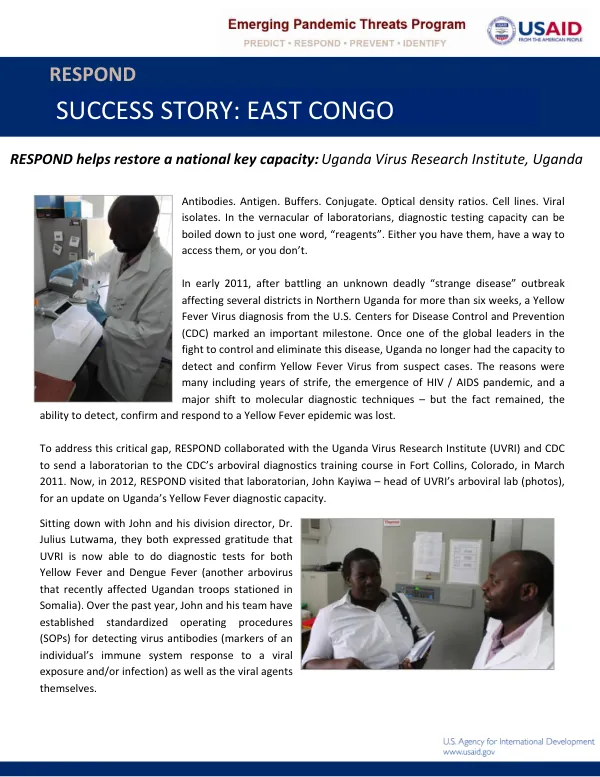
Centers for Disease Control and Prevention (CDC) to address a critical gap in Uganda's ability to detect and confirm Yellow Fever Virus. In early 2011, a Yellow Fever Virus diagnosis from the CDC marked an important milestone, as Uganda had lost the capacity to detect and confirm the disease due to years of strife, the emergence of the HIV/AIDS pandemic, and a shift to molecular diagnostic techniques. To address this gap, RESPOND sent a laboratorian to the CDC's arboviral diagnostics training course in Fort Collins, Colorado, in March 2011. The laboratorian, John Kayiwa, is the head of UVRI's arboviral lab. In 2012, RESPOND visited John and his division director, Dr. Julius Lutwama, for an update on Uganda's Yellow Fever diagnostic capacity. John and Dr. Lutwama expressed gratitude that UVRI is now able to do diagnostic tests for both Yellow Fever and Dengue Fever, another arbovirus that recently affected Ugandan troops stationed in Somalia. Over the past year, John and his team have established standardized operating procedures (SOPs) for detecting virus antibodies and the viral agents themselves. Prior to the Fort Collins training course, UVRI was only able to detect a single type of antibodies to the Yellow Fever Virus, but was unable to confirm a diagnosis. John and Dr. Lutwama anticipate developing SOPs for about 15-20 different viral pathogens, including Rift Valley Fever, West Nile Virus, Chikungunya Virus, and Semliki Forest Virus. The arboviral lab at UVRI receives on average three suspect samples to test for Yellow Fever each week, most coming from sick people in the same area affected by the 2010 outbreak. The suspect samples are first tested for Ebola Virus and Marburg Virus, as these are of greater concern to both national and global health authorities, and are biosecurity level 4 (or "hot") pathogens. They also run another 10 samples per week coming from patients suspected to have Hepatitis E, a disease with a clinical presentation similar to Yellow Fever thought to be endemic in the same area where the 2010 outbreak occurred. John has trained a technician in his lab, and another UVRI colleague was trained in Dakar, Senegal, bringing Uganda's national human resource capacity for arboviral diagnostics to three people. When John returned from the arboviral diagnostic training course, he came with positive and negative controls for Yellow Fever Virus, which were not previously available in Uganda. He has maintained stocks of these reagents, as well as collaborative relationships with other laboratories that source them. Reagents for Dengue Fever diagnostics were made available through a collaborative relationship with a CDC's Dengue laboratory in Puerto Rico. The interconnection and interdependence between infectious diseases, human beings, domestic animals, wild animals, and the environment makes for fierce competition between laboratories for resources and reagents to diagnose diseases. The arboviral lab at UVRI is optimistic that the re-established capacity to maintain reagent stocks, and develop their own, will provide a benefit, strengthening collaborative opportunities with other labs. Together with the Ugandan government, UVRI, World Health Organization, and CDC, RESPOND has provided demonstrable, measurable results in 2012 through re-establishing a critical diagnostic capacity for the country of Uganda.
Related documents