THE WORLD FOOD PROGRAMME
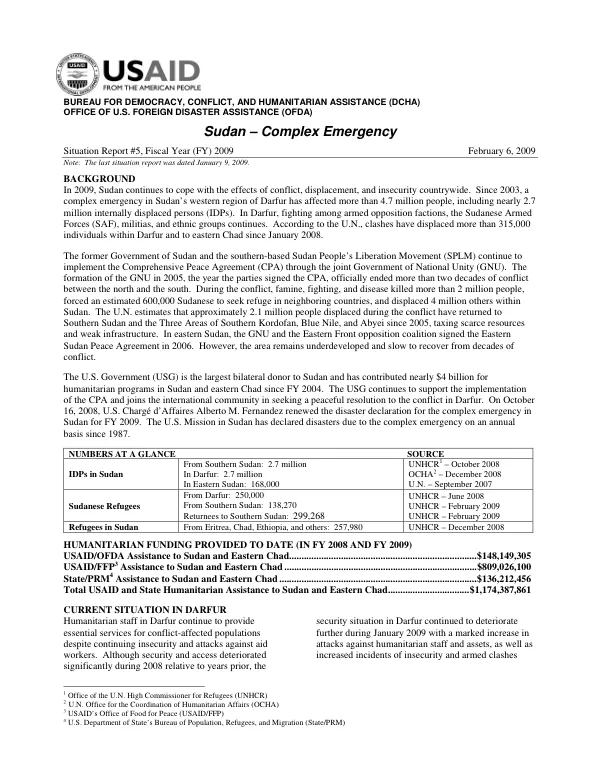
Sudan Complex Emergency Situation Report #5 02/06/09
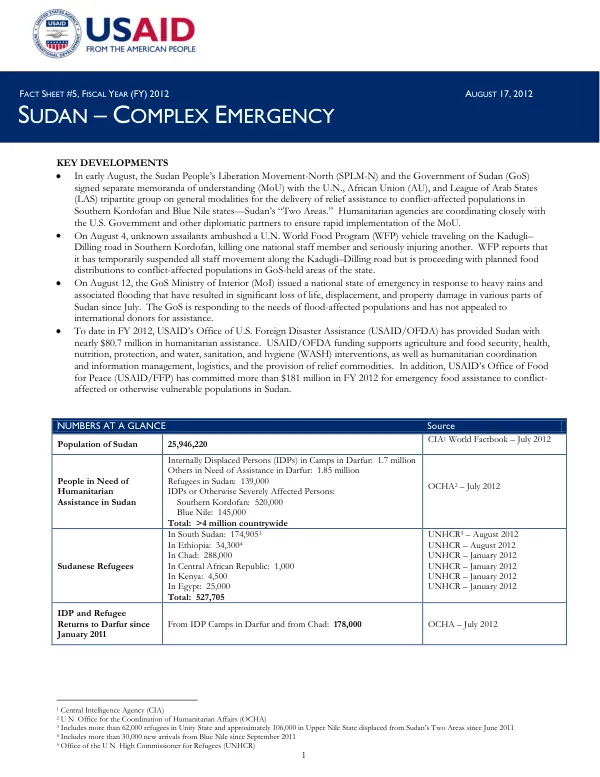
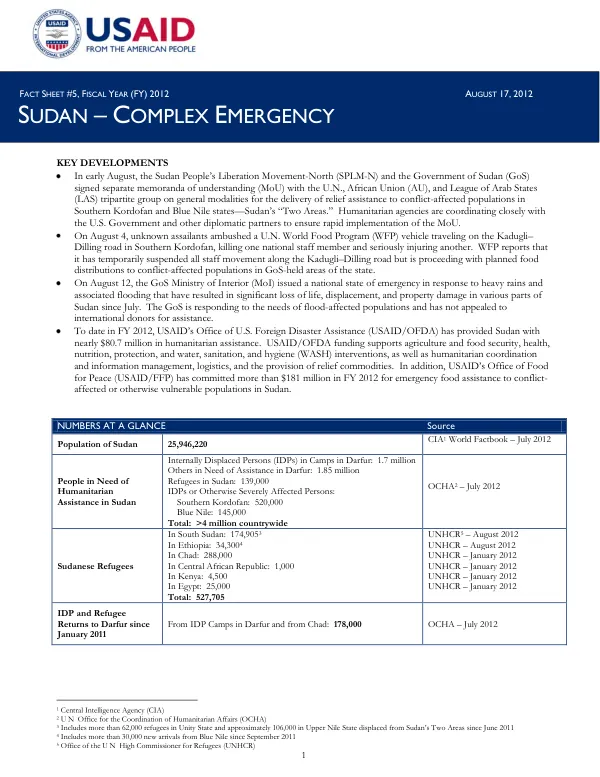
The complex emergency in Sudan continues to affect more than 4.7 million people, including nearly 2.7 million internally displaced persons (IDPs).
2009 · 9 pages
Sign in to readA free account is required to download.
Abstract
Since 2003, a complex emergency in Sudan's western region of Darfur has resulted in significant displacement and insecurity. Fighting among armed opposition factions, the Sudanese Armed Forces (SAF), militias, and ethnic groups continues, with clashes displacing more than 315,000 individuals within Darfur and eastern Chad since January 2008. The Comprehensive Peace Agreement (CPA) signed in 2005 officially ended more than two decades of conflict between the north and the south. However, the area remains underdeveloped and slow to recover from decades of conflict. The U.S. Government (USG) is the largest bilateral donor to Sudan, having contributed nearly $4 billion for humanitarian programs in Sudan and eastern Chad since FY 2004. The USG continues to support the implementation of the CPA and joins the international community in seeking a peaceful resolution to the conflict in Darfur. Humanitarian staff in Darfur continue to provide essential services for conflict-affected populations despite ongoing insecurity and attacks against aid workers. The security situation in Darfur continued to deteriorate further during January 2009, with a marked increase in attacks against humanitarian staff and assets, as well as increased incidents of insecurity and armed clashes. The U.S. Air Force commenced airlifts of heavy machinery to support the African Union–U.N. Hybrid Operations in Darfur (UNAMID) in January, with the goal of transporting nine vehicles on five flights, including 20,000-pound trucks equipped with cranes to enable peacekeepers to repair vehicles along patrol routes. Security and humanitarian access remain significant concerns in Darfur. Attacks against aid workers and ongoing clashes continue to limit humanitarian access to affected populations throughout Darfur, particularly in Muhajeria, South Darfur. The recent increase in attacks and insecurity has forced nearly 10 humanitarian agencies to suspend vital assistance and services in many areas of North and South Darfur. In South Darfur, the GNU Humanitarian Aid Commission (HAC) banned the transport and delivery of food aid and emergency relief supplies to areas under control of the Justice and Equality Movement (JEM) armed opposition group. Population movements have increased in response to the ongoing violence and insecurity in Darfur. Humanitarian staff reported large numbers of trucks driving north towards El Fasher town carrying IDPs fleeing attacks on North Darfur's southern villages, as well as individuals arriving at Zam Zam camp after fleeing Muhajeria town. According to several local reports, government officials prevented newly displaced populations from entering some El Fasher-area IDP camps, including Al Salaam and Zam Zam camps.
Related documents