BANYAN GLOBAL
Supporting Women’s Economic Empowerment and Gender Equality Through Trade
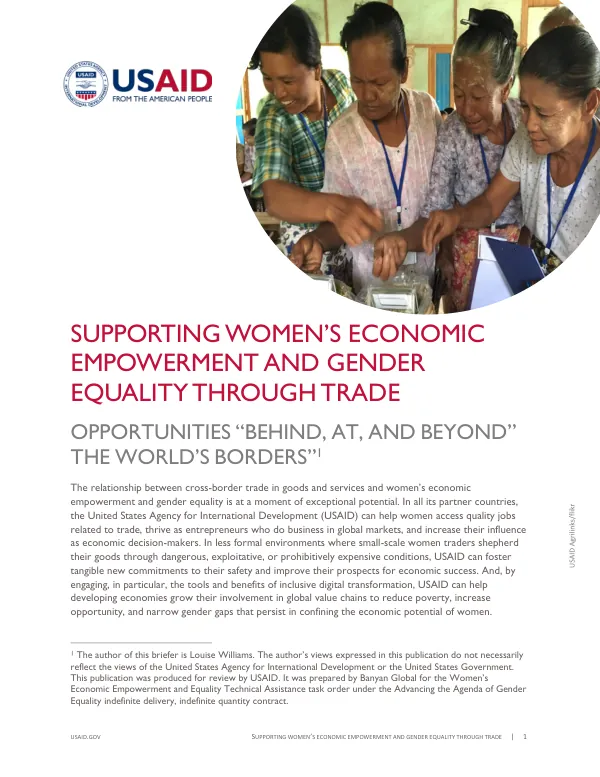
The relationship between cross-border trade in goods and services and women's economic empowerment and gender equality is at a moment of exceptional potential.
2021 · 9 pages
Sign in to readA free account is required to download.
Abstract
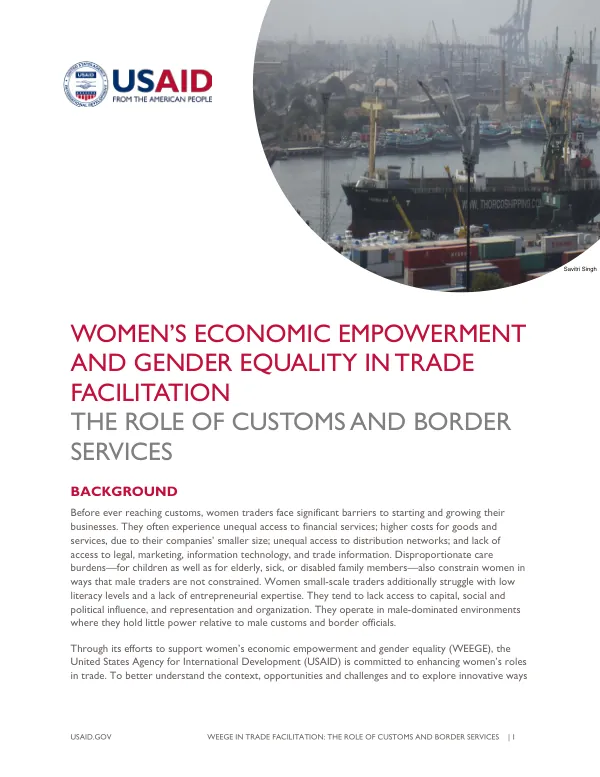
In all its partner countries, the United States Agency for International Development (USAID) can help women access quality jobs related to trade, thrive as entrepreneurs who do business in global markets, and increase their influence as economic decision-makers. Women's participation in cross-border trade is significant, with women comprising as much as 70 percent of cross-border traders in Africa. Although many women have flourished and built successful enterprises around this role, conditions on the ground for the majority persist in making it harder for them to obtain necessary paperwork, receive fast and efficient service, and pass through customs without being subjected to sex discrimination, bribery, corruption, or sexual exploitation. The current landscape of cross-border trade presents increasing opportunities for women business owners or employees in trade-related jobs, particularly in digital and data flows among economies and enterprises, and in expanded trade in services, including in sectors such as education, health, agriculture, and tourism. Informal women traders face the imperative of finding paths toward resuming and exceeding previous levels of productivity, including by responding to new health and safety restrictions at the borders and increasing their use of financial and information tools available through digital technologies. For USAID, opportunities abound to assist women in expanding and strengthening their participation in cross-border trade, as self-employed traders and entrepreneurs; as workers who support existing and evolving global value chains; and as influencers and decision-makers in the global economy. Inroads can be found at the major junctures of the trade process: "behind the border," where enterprises are established and grow their capacities to trade; "at the border," which includes tangible border-crossings and online trade facilitation services; and "beyond the border," which refers to the formal systems of trade more broadly. Entrepreneurs launch and grow their firms against the backdrop of a country's business-enabling environment, which encompasses the full range of structural conditions and regulatory issues that influence their ability to compete locally or across borders. For women, these issues extend into considerations such as social norms, stereotypes, and expectations that impact women's personal journeys and economic choices beginning in childhood. Women are overrepresented in lower-paying jobs and unpaid care work; less likely than men to own or control productive assets; and more vulnerable to economic shocks, such as those triggered by the spread of COVID-19. The economic inequalities between men and women, though narrowing somewhat, remain stark. In access to capital, real property, and other resources, gender gaps persist across all avenues of economic opportunity. Women's legislated and customary treatment of property impacts their capacity to invest in themselves, and they are deprived of one of the primary mechanisms for accumulating assets. Worldwide, many women continue to be discouraged from holding jobs outside the home, and those who do work for wages are far more likely than men to labor informally. USAID's economic growth activities, including economic policy and analysis, private-sector development, assistance in creating more and better jobs for workers, trade and regulatory reform, energy and infrastructure, digital inclusion, and financial inclusion, offer opportunities to help women expand their access to cross-border trade. By addressing the structural conditions and regulatory issues that influence women's ability to compete locally or across borders, USAID can help women overcome the barriers that prevent them from participating fully in cross-border trade and achieving their economic potential.
Related documents