USAID DEC
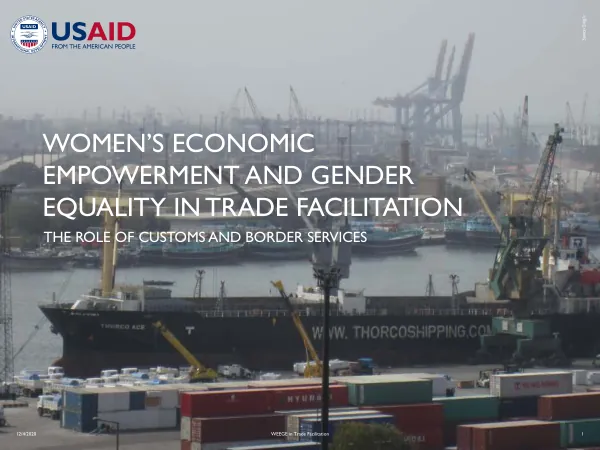
Women’s Economic Empowerment and Gender Equality in Trade Facilitation: The Role of Customs and Border Services
Sign inBANYAN GLOBAL
Women’s Economic Empowerment and Gender Equality in Trade Facilitation: The Role of Customs and Border Services
The Women's Economic Empowerment and Gender Equality (WEEGE) initiative in trade facilitation aims to enhance women's roles in trade.
2020 · 9 pages
Sign in to readA free account is required to download.
Abstract
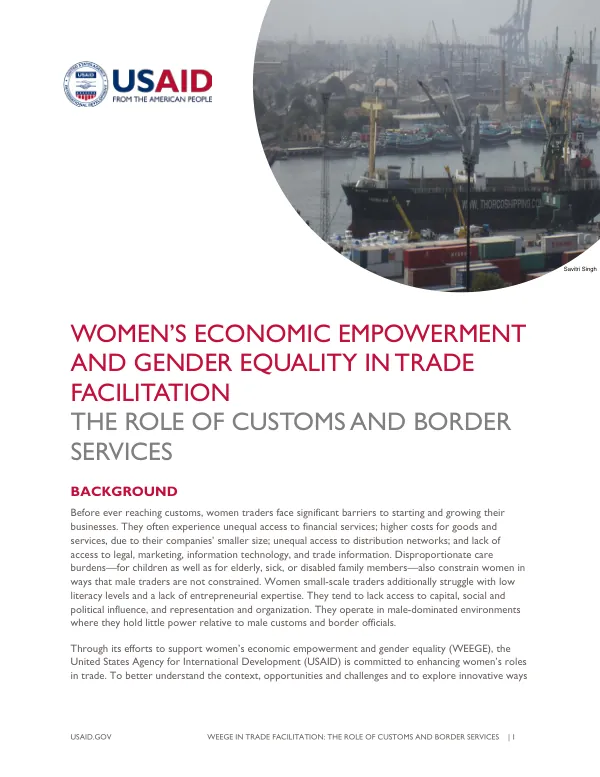
The initiative focuses on the role of customs and border services in facilitating trade and promoting gender equality. Women traders face significant barriers to starting and growing their businesses, including unequal access to financial services, higher costs for goods and services, and lack of access to distribution networks. Customs services operate in a complex environment, serving dual and competing roles of enforcing laws to protect the country's health, safety, and security while facilitating trade and revenue collection. Empowering women traders can have a positive impact on expanding trade, and customs services' policies and rules must support efficient, effective, and gender-sensitive border management. A WEEGE assessment conducted by Banyan Global identified several key findings. Neutral implementation of laws results in an unintentional bias against small and medium-sized enterprises (SMEs), which are predominantly owned by women. Governments often fail to consider women traders' needs in formulating trade initiatives, and women need access to innovative trade facilitation technology. Lack of trade information is a major barrier for female-owned SMEs and small-scale traders, and customs officers sometimes lack sufficient knowledge of rules and procedures. The assessment also highlighted the importance of addressing structural barriers, such as unequal access to information, networks, and capital, or social norms that favor male leadership. In some cases, customs officers have an opportunity to empower women traders through targeted outreach efforts. However, in other cases, women traders operate in vulnerable positions and unsafe conditions, with increased costs and barriers to success. The report provides several recommendations for customs administrations, governments, and other stakeholders to promote WEEGE in trade facilitation. These recommendations include adopting sensitive, efficient, and effective border management policies, requiring adherence to statutory deadlines, and considering women's economic empowerment and gender equality when formulating trade initiatives and customs policies. The report also highlights the importance of providing transparent and easy-to-access customs information, updating and ongoing training to customs officials, and working with Chambers of Commerce and women's associations to outreach to potential SME traders. In advanced economies, the report recommends maintaining updated systems and continuing to implement trade facilitation measures. In emerging economies, the report recommends implementing full automation and trade facilitation measures, developing clear and transparent procedure guides, and adopting a Charter of Rights for traders. Overall, the WEEGE initiative in trade facilitation aims to promote gender equality and empower women traders by addressing the barriers they face in accessing trade opportunities. By implementing the recommendations outlined in the report, customs administrations and governments can promote more equitable access, treatment, and opportunities for women in trade.