IMPERIAL COLLEGE LONDON
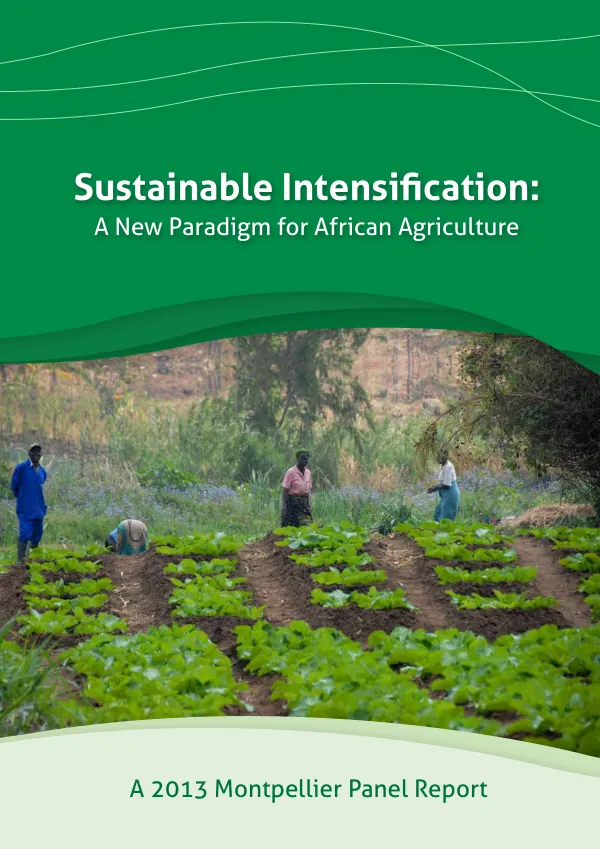
Sustainable Intensification: A New Paradigm for African Agriculture
Sustainable Intensification: A New Paradigm for African Agriculture is a 2013 report by the Montpellier Panel.
2013 · 36 pages
Sign in to readA free account is required to download.
Abstract
The report emphasizes the need for a new approach to tackle food insecurity in Africa, where natural resources are in short supply and nearly one in four people suffer from chronic hunger. The panel believes that sustainable intensification offers a practical pathway towards producing more food with less environmental impact. The report highlights the challenges faced by sub-Saharan Africa, including a rapidly growing population, increasing food demand, and scarce resources such as land, water, and soil fertility. The current model of intensification, which has served well for a hundred years, is no longer viable due to the changing context. The report argues that conventional intensification is not a sustainable solution if it comes at the expense of environmental and social resources. The Montpellier Panel recommends that governments in developed and African countries, in partnership with the private sector, civil society organizations, and non-governmental organizations, recognize and act on the paradigm of sustainable intensification. This includes adopting policies and plans that combine intensification with sustainable solutions, increasing financial support for research and innovation, and scaling up and out of effective technologies and processes. The report emphasizes the need for a multi-faceted approach to sustainable intensification, which includes ecological and genetic intensification, within enabling environments created by socio-economic intensification. The panel highlights the importance of combining these components as a framework to find appropriate solutions to Africa's food and nutrition crisis. The report also highlights the challenges faced by sub-Saharan Africa, including a high prevalence of chronically hungry people, a rapidly growing population, and insufficient or declining food supplies. The panel notes that demand is increasing while supply is insufficient or even declining, and that the population in SSA will almost double by 2050. The report also discusses the lack of land and water in sub-Saharan Africa, highlighting that more land could be brought into production, but that this is not happening. The panel notes that the harvested areas for major food crops have remained more or less constant, with oil crops being the only exception. The report also highlights the importance of water conservation, noting that in SSA only 4% of cultivated land is irrigated. The Montpellier Panel's report emphasizes the need for a new approach to tackle food insecurity in Africa, and highlights the importance of sustainable intensification as a practical pathway towards producing more food with less environmental impact. The report provides a framework for finding appropriate solutions to Africa's food and nutrition crisis, and emphasizes the need for a multi-faceted approach that combines ecological and genetic intensification, within enabling environments created by socio-economic intensification.