OPEN UNIVERSITY
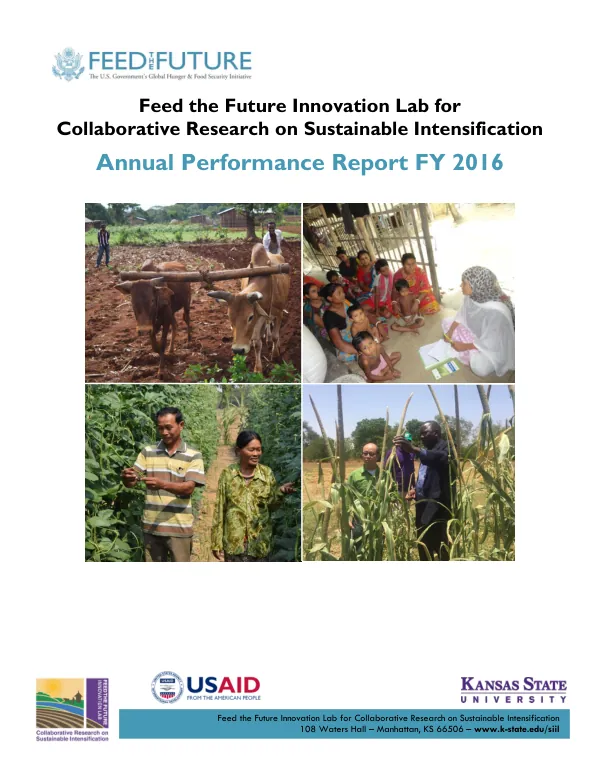
Sustainable Intensification Innovation Lab Annual Performance Report – FY 2016
The Feed the Future Innovation Lab for Collaborative Research on Sustainable Intensification is a research initiative focused on improving agricultural productivity and sustainability in developing countries.
2016 · 55 pages
Sign in to readA free account is required to download.
Abstract
The lab is based at Kansas State University and is supported by the United States Agency for International Development (USAID). The lab's research activities are centered around three main consortia: the Geospatial and Farming Systems Research Consortium (GFC), the Appropriate Scale Mechanization Consortium (ASMC), and the Center of Excellence on Sustainable Agricultural Intensification and Nutrition (CE SAIN). The GFC is a research consortium that focuses on the use of geospatial and farming systems research to improve agricultural productivity and sustainability. The consortium is composed of researchers from various institutions and is led by Kansas State University. The GFC has conducted research in several countries, including Bangladesh, Burkina Faso, Cambodia, and Ethiopia. The research has focused on the use of precision agriculture techniques, such as satellite imaging and GPS technology, to improve crop yields and reduce the environmental impact of agriculture. The ASMC is another research consortium that focuses on the development of appropriate scale mechanization technologies for smallholder farmers. The consortium is also composed of researchers from various institutions and is led by Kansas State University. The ASMC has conducted research in several countries, including Bangladesh, Burkina Faso, Cambodia, and Ethiopia. The research has focused on the development of mechanization technologies that are suitable for smallholder farmers and can help to improve their productivity and efficiency. The CE SAIN is a research center that focuses on sustainable agricultural intensification and nutrition. The center is based in Cambodia and is led by Kansas State University. The CE SAIN has conducted research on the impact of sustainable agricultural practices on food security and nutrition in Cambodia. The research has focused on the use of conservation agriculture techniques, such as no-till farming and crop rotation, to improve soil health and reduce the environmental impact of agriculture. The lab has also conducted research on the development of indicators for sustainable intensification. The research has focused on the development of a set of indicators that can be used to measure the impact of sustainable agricultural practices on food security and nutrition. The indicators include metrics such as crop yields, soil health, and water use efficiency. In addition to research, the lab has also conducted training and capacity building activities. The lab has provided short-term and long-term training to researchers and extension agents in several countries. The training has focused on topics such as sustainable agriculture, precision agriculture, and mechanization technologies. The lab has also provided institutional development support to several institutions in developing countries. The lab has also established partnerships with several organizations to transfer and scale up innovations. The partnerships have focused on the development of technologies and practices that can be used by smallholder farmers to improve their productivity and efficiency. The innovations include precision agriculture technologies, mechanization technologies, and sustainable agriculture practices. Overall, the Feed the Future Innovation Lab for Collaborative Research on Sustainable Intensification is a research initiative that is focused on improving agricultural productivity and sustainability in developing countries. The lab's research activities are centered around three main consortia: the GFC, the ASMC, and the CE SAIN. The lab has also conducted training and capacity building activities and has established partnerships with several organizations to transfer and scale up innovations.