GLOBAL COMMUNITIES
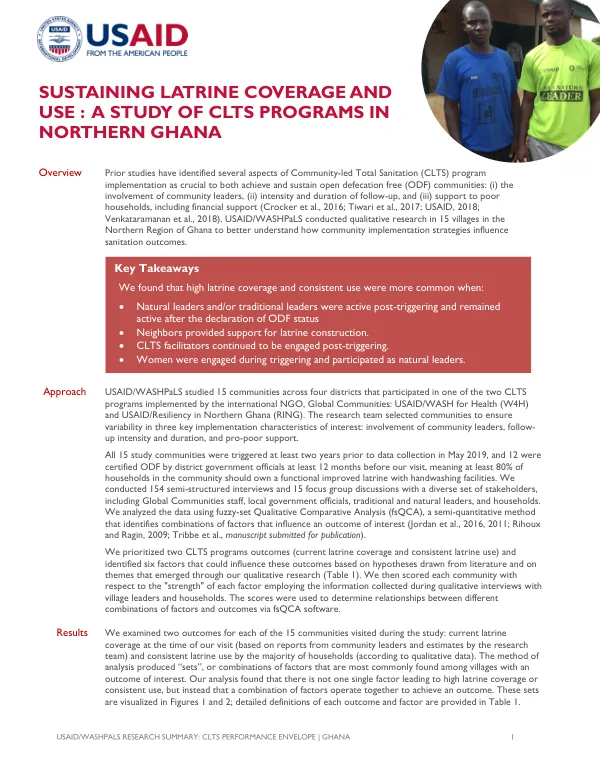
Sustaining Latrine Coverage and Use: A Study of CLTS Programs in Northern Ghana
Community-led Total Sanitation (CLTS) programs in Northern Ghana have been studied to understand the factors influencing sanitation outcomes.
2021 · 6 pages
Sign in to readA free account is required to download.
Abstract
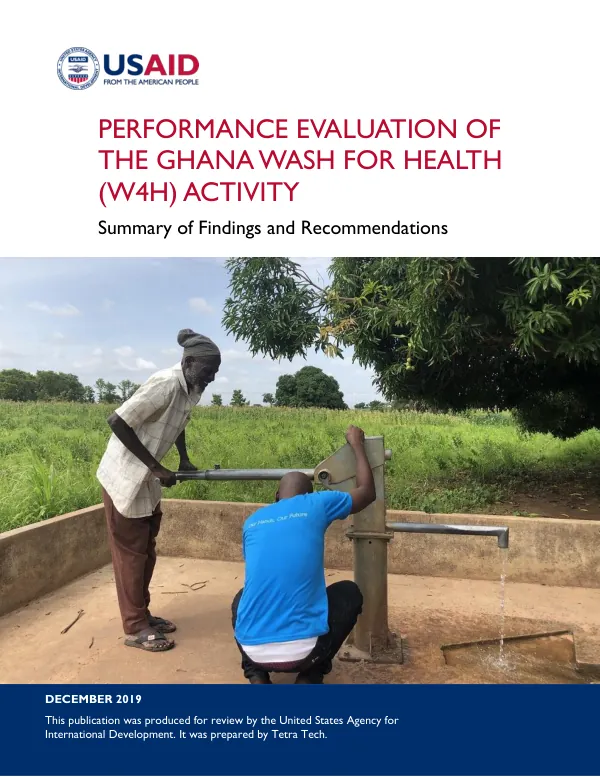
Research conducted by USAID/WASHPaLS in 15 villages across four districts identified several key implementation characteristics that contribute to achieving and sustaining open defecation free (ODF) communities. The study focused on two CLTS programs implemented by the international NGO, Global Communities: USAID/WASH for Health (W4H) and USAID/Resiliency in Northern Ghana (RING). The research team selected communities to ensure variability in three key implementation characteristics: involvement of community leaders, follow-up intensity and duration, and pro-poor support. All 15 study communities were triggered at least two years prior to data collection in May 2019, and 12 were certified ODF by district government officials at least 12 months before the visit. The research team conducted 154 semi-structured interviews and 15 focus group discussions with a diverse set of stakeholders, including Global Communities staff, local government officials, traditional and natural leaders, and households. Fuzzy-set Qualitative Comparative Analysis (fsQCA) was used to analyze the data, identifying combinations of factors that influence sanitation outcomes. The study found that high latrine coverage and consistent use were more common when natural leaders and/or traditional leaders were active post-triggering and remained engaged after the declaration of ODF status. Neighbors provided support for latrine construction, and CLTS facilitators continued to be engaged post-triggering. Women were also engaged during triggering and participated as natural leaders. The analysis revealed that there is not one single factor leading to high latrine coverage or consistent use, but instead, a combination of factors operate together to achieve an outcome. The study identified six factors that could influence these outcomes, including the involvement of community leaders, follow-up intensity and duration, and pro-poor support. The research found that communities with high latrine coverage saw high engagement from a combination of actors internal and external to the community. Traditional leaders, such as chiefs or community elders, and "natural leaders" (community volunteers selected by the community itself during triggering) took on specific roles to support latrine construction and use. Follow-up by external CLTS facilitators following the ODF declaration, when it occurred together with high engagement from traditional leaders, was also associated with high latrine coverage. The study also identified a single necessary factor for consistent latrine use: neighbors helping neighbors, including poor and vulnerable households, construct latrines. Most community members in the study communities rarely acknowledged any of their neighbors as poor or vulnerable, stating that "we are all poor," or that there is no excuse for not building a latrine given that the materials are "free." The research highlights the importance of community engagement and support in achieving and sustaining ODF communities. The study's findings suggest that a combination of factors, including the involvement of community leaders, follow-up intensity and duration, and pro-poor support, contribute to achieving high latrine coverage and consistent use. The study's results also emphasize the importance of neighbors helping neighbors, including poor and vulnerable households, construct latrines, and the role of women in maintaining latrines over time.
Related documents