TETRA TECH
Supporting Deforestation-Free Cocoa in Ghana: Planning Workshop Report
The Integrated Land and Resource Governance (ILRG) task order under the Strengthening Tenure and Resource Rights II (STARR II) Indefinite Delivery/Indefinite Quantity (IDIQ) contract is continuing work on sustainability of deforestation-free cocoa originally commenced under the Tenure and Global Climate Change (TGCC) program.
2018 · 29 pages
Sign in to readA free account is required to download.
Abstract
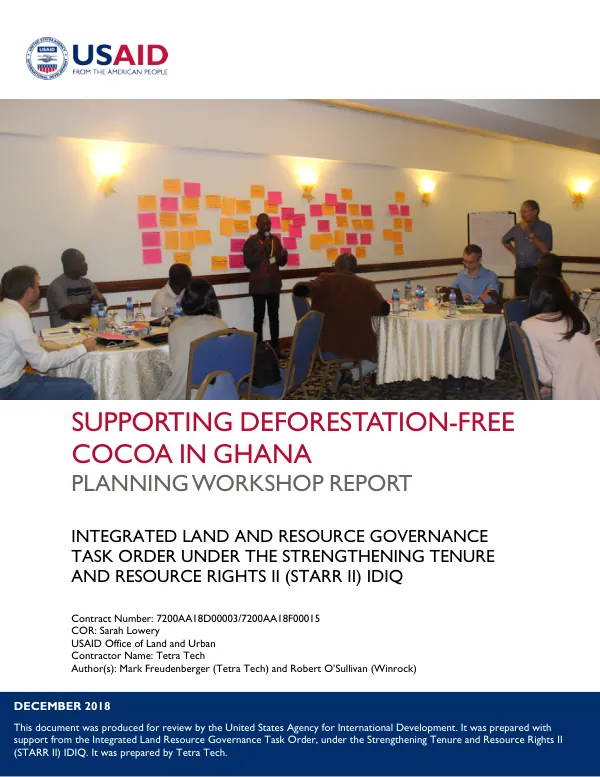
This effort is managed by the United States Agency for International Development's (USAID) Land and Urban Office. The ILRG task order held a planning workshop with key project stakeholders to refine activities for the anticipated two-year bridge phase activity, clarify roles and responsibilities of actors, and define an activity timeline. The Supporting Deforestation-Free Cocoa in Ghana planning workshop was held November 13 – 14, in Accra, Ghana. A total of 29 participants (some of whom participated via webinar) engaged actively in discussions around four central themes. The first theme focused on the environmental and social dynamics of deforestation and cocoa, looking at the case of Wassa Amenfi West District. This discussion highlighted the complex relationships between cocoa production, deforestation, and climate change in the region. The second theme centered on farm-level clarification and documentation of land and tree tenure rights, emphasizing the importance of secure land tenure for sustainable cocoa production. The third theme explored experiences, challenges, and future perspectives with land use planning in Ghana's cocoa forest landscape. Participants shared insights on the successes and limitations of land use planning initiatives in the region, including the need for more effective coordination among stakeholders. The fourth theme focused on farm-level renovation of cocoa farms, highlighting the potential for renovation to improve cocoa yields and reduce deforestation. Throughout the workshop, the cross-cutting theme of gender integration and social inclusion was discussed, with a presentation focused on the importance of involving women and marginalized groups in cocoa production and land use planning. Additional sessions included a summary of the work by the USAID Climate Economic Analysis for Development, Investment, and Resilience (CEADIR) project, which highlighted the need for more effective climate change mitigation and adaptation strategies in the cocoa sector. The workshop aimed to refine activities for the anticipated two-year bridge phase activity, clarify roles and responsibilities of actors, and define an activity timeline. The outcomes of the workshop will inform the development of a comprehensive plan to support deforestation-free cocoa production in Ghana, with a focus on improving land tenure security, promoting sustainable land use practices, and enhancing the livelihoods of cocoa farmers and their communities.