INSTITUTE FOR INTERNATIONAL DEVELOPMENT, INC.
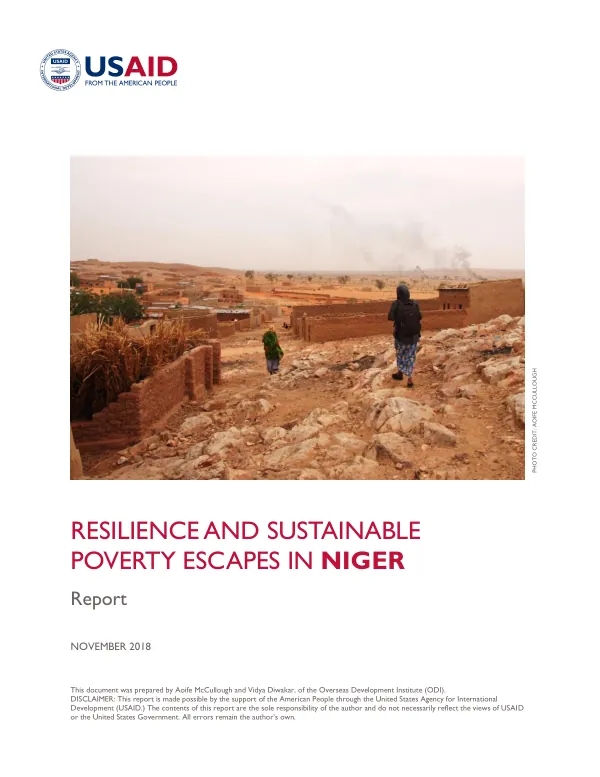
Sustaining Poverty Escapes in Niger
The political, economic, social, and environmental context for poverty reduction in Niger is challenging.
2018 · 20 pages
Sign in to readA free account is required to download.
Abstract
The country faces security challenges from Boko Haram and the Islamic State in Greater Sahara, as well as internally. Niger has a history of low and volatile economic growth, dependent on minerals and agriculture, and now faces low commodity prices and low levels of public revenues to improve its position in the Human Development Index. The country is drought-prone and vulnerable to climate change, creating a complex risk environment that affects poverty reduction both directly and indirectly. Aid to Niger has increased, but given its poverty levels, it may still be under-aided. In the short term, development partners and NGOs may be able to help prepare the ground for medium-term programming. However, in the medium term, the government and its development partners could attempt to reduce exposure to risk and strengthen poor people's resilience. Social protection needs to be more widely available and strongly embedded in national systems. Agriculture can be made less risky by supporting investments in irrigation, which many small farmers are already doing. Livestock is seriously under-supported, and reducing the risks of livestock deaths from disease or drought is worth supporting strongly, as livestock represent rural people's major form of saving. Diversification is an important pathway to sustained escapes from poverty, and extending rural electrification from a very low base could be an important support for this. Trade provides opportunities for escaping poverty, but the infrastructure for effective markets relies on myriad small and often informal initiatives. Current initiatives to tax traders may have negative effects on this pathway out of poverty. Migration is also a critical pathway to diversification, and given hostile contexts for migrants in Nigeria and Libya, internal migration has become more important than it was. Development policy and programming in Niger could learn from various migrant support initiatives in Asia, such as the 2008 New Labor Contract Law in China and Pourakhi in Nepal. Early marriage is a sensitive issue that is a cause of impoverishment, and while several initiatives have been taken in Niger, the results have not yet been assessed. A comprehensive evaluation of current and recent projects is recommended, in addition to developing a systematic approach to better address this issue. It is urgent to scale up the basic World Bank-supported social protection scheme Niger has, which remains highly inadequate in terms of coverage, given the high level of uninsured risk faced by poor and vulnerable people. A health insurance scheme would be needed to prevent the widespread impoverishing effects of ill health. A conflict period could be a good time to experiment with different approaches and develop a 'learning umbrella' within which these could shelter, so that political parties can assess the advantages of such a scheme and campaign on it politically at a future election. In the short to medium term, public resources have been concentrated in the defense services, to the detriment of social and economic services and investments. This means that any policy implications drawn from this research are probably only relevant for the medium term, post-conflict era. In the short term, ending the war and getting public expenditure back into supporting development efforts must be the priority. The quality of governance is a key variable determining what can be done to respond to these challenges and reduce poverty.