INSTITUTE FOR INTERNATIONAL DEVELOPMENT, INC.
Resilience and Sustainable Poverty Escapes in Niger
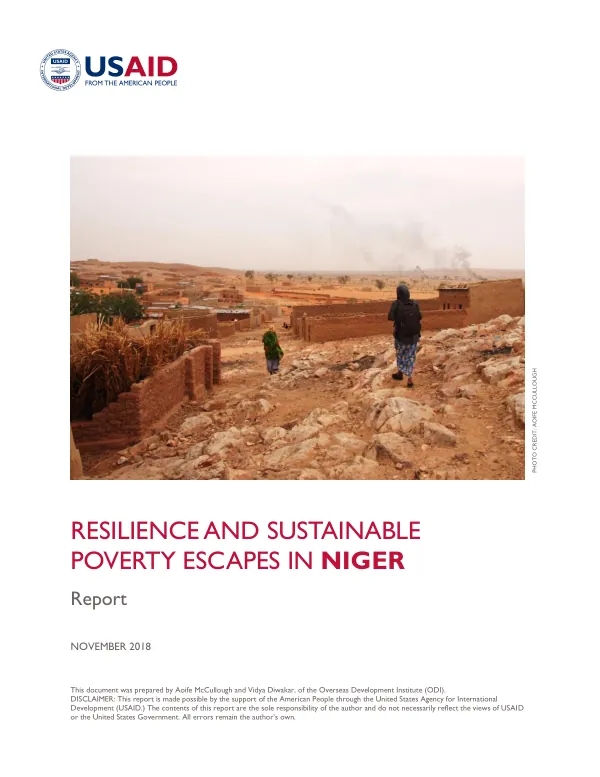
Resilience and Sustainable Poverty Escapes in Niger is a report that focuses on household poverty dynamics, specifically escapes and descents, with a focus on what explains why some households escape poverty and remain out of poverty, while others escape poverty only to fall back into it.
2018 · 45 pages
Sign in to readA free account is required to download.
Abstract
The report combines analysis from two rounds of the Living Standards Measurements Survey - National Survey on Household Living Conditions and Agriculture in 2011 and 2014 for this case study, which reveals that poverty escapes and descents are significant phenomena in Niger. The report examines the resources, attributes, and activities that enable households to escape poverty sustainably and minimize the likelihood of returning to living in poverty again. The research found that households with increased land, and who developed a nonfarm enterprise, or received remittances from domestic sources, between 2011 and 2014 were associated with significantly higher monetary welfare measured by per capita expenditures. The qualitative data indicated that households with these characteristics and who diversified their assets were more likely to experience sustained than transitory escapes from poverty. In the life history interviews, most increases in landholdings were through inheritance. Combining domestic or international migration with farm activities was a common strategy in rural areas and was likely to lead to escapes from poverty. However, these escapes from poverty were often transitory with many experiencing job insecurity and shocks which resulted in a fall back into poverty. The difference between sustained escapers and transitory escapers who combined migration with agriculture is that sustained escapers had a network that linked them to more lucrative trades such as masonry, security or the fuel trade. The risk environment is extremely challenging for poor and near-poor people in Niger. Environmental and agriculture-related shocks were the most common in the quantitative data; ill health figured prominently in the qualitative research data. Price shocks were associated with significantly reduced monetary welfare in the quantitative results. Coping strategies in the quantitative dataset included the use of savings, engaging in spiritual activities, and seeking help from relatives and friends. The changing characteristics of households were also particularly important in impoverishment processes. Having more children, teenage marriage, especially for women just above the poverty line, were all associated with an increased likelihood of a descent into poverty in the qualitative research data. Strategies for sustained poverty escapes evidenced in the qualitative data included investing in livestock, agricultural land, vegetable gardening, and urban property. Livestock investments were the most risky investment; livestock often succumbed to disease or starvation. Spreading the risks through diversifying investments was more common among sustained escapers. Sustained escapers were also able to use family connections to help them recover from shocks, for example, to secure jobs in Nigeria. Several female interviewees were able to achieve a sustained escape though investing in livelihood assets such as push carts for transporting water and peanut oil extraction equipment from formal savings groups and money contributed at baptism ceremonies. The report highlights the importance of understanding the complex factors that influence poverty dynamics in Niger, and the need for policies and programs that support households in their efforts to escape poverty sustainably. The report's findings have implications for poverty reduction strategies in Niger and other countries with similar contexts.
Related documents