INSTITUTE FOR INTERNATIONAL DEVELOPMENT, INC.
Sustaining Poverty Escapes in Rural Cambodia
The research focuses on the drivers of sustained poverty escapes in rural Cambodia.
2018 · 21 pages
Sign in to readA free account is required to download.
Abstract
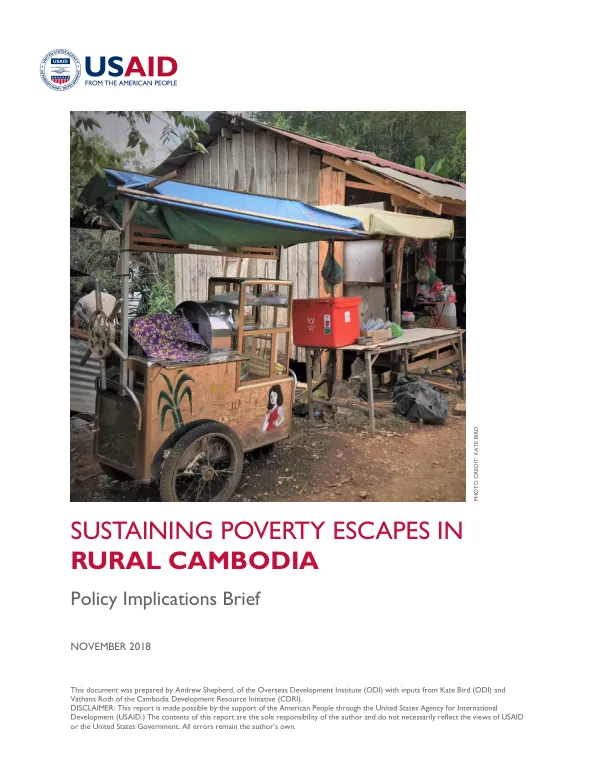
The study investigates the factors that enable households to escape poverty and remain out of it over a period of time. The research combines analysis from four rounds of the panel Agriculture, Rural Development and Poverty Reduction Survey in Cambodia spanning 2008-2017, with qualitative research approaches, including key informant interviews, life histories, and focus group discussions in 6 study sites across Cambodia's major agro-ecological zones. The study found that just under one fifth of households escaped poverty and stayed out of poverty, while almost the same share escaped only to fall back in, or became impoverished for the first time, over the study period. There is considerable dynamism in rural households' poverty status, with almost 4 in 5 households living in poverty during at least one of the 2008-17 survey years. The research identified several factors that contribute to sustainable poverty escapes in Cambodia. Initial household resource base is an important factor, with households that have a higher initial resource base being more likely to escape poverty and remain out of it. Agricultural land is also important, with life history interviewees indicating that it is essential to protect household wellbeing, despite low holdings observed in the panel data and low and variable returns to agriculture observed in the qualitative data. Livestock is the resource variable that is associated with the largest reduction in poverty, according to the regression analysis. The study also found that household composition and education level are important attributes that enable households to escape poverty and minimize the likelihood of returning to living in poverty again. The research highlights the importance of cross-sectoral responses in sustaining poverty escapes over time. The study suggests that a portfolio approach to policy making or programming is necessary to address the complex and inter-related factors that contribute to poverty dynamics in rural Cambodia. In terms of policy and programming implications, the study recommends that policymakers and programmers focus on enabling poor children to stay in school for longer, expanding social protection and especially health insurance, supporting poor people's engagement in agriculture, and supporting internal migration. The study also highlights the need for more frequent revisions of the ID Poor lists to take account of changes in wellbeing, so that access can more accurately reflect changing circumstances. The research also emphasizes the importance of addressing the root causes of poverty, including the intergenerational transmission of poverty, and the need for a comprehensive approach to poverty reduction that takes into account the complex and inter-related factors that contribute to poverty dynamics in rural Cambodia. The study's findings have implications for the design and implementation of poverty reduction programs in Cambodia. The research suggests that programs should focus on building the capacity of poor households to escape poverty and remain out of it over time, rather than just providing temporary assistance. The study also highlights the need for more effective targeting of poverty reduction programs, taking into account the complex and inter-related factors that contribute to poverty dynamics in rural Cambodia. The research also has implications for the development of policies and programs that aim to reduce poverty in rural Cambodia. The study suggests that policies and programs should focus on building the capacity of poor households to escape poverty and remain out of it over time, rather than just providing temporary assistance. The study also highlights the need for more effective targeting of poverty reduction programs, taking into account the complex and inter-related factors that contribute to poverty dynamics in rural Cambodia.