USAID DEC
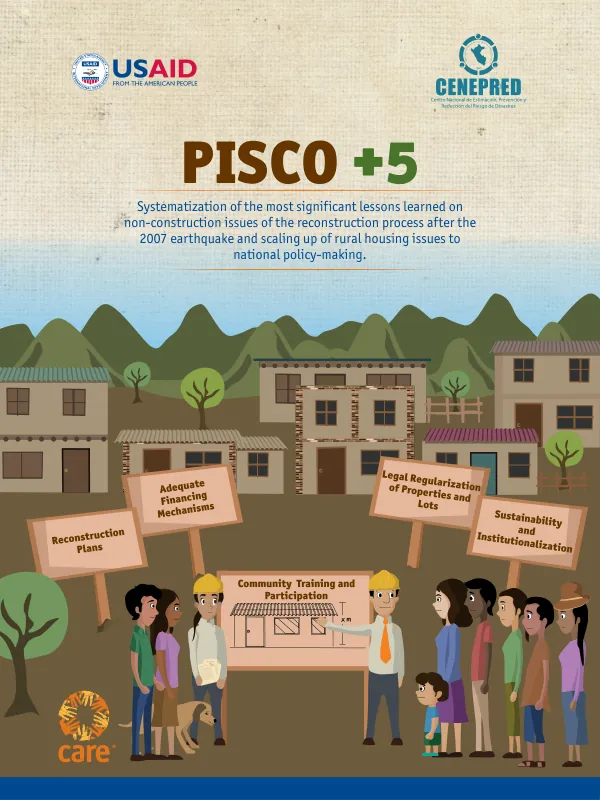
Systematization of the most significant lessons learned on non-construction issues of the reconstruction process after the 2007 earthquake and scaling up of rural housing issues to national policy-making.
Sign inCARE
Systematization of the most significant lessons learned on non-construction issues of the reconstruction process after the 2007 earthquake and scaling up of rural housing issues to national policy-making.
The systematization of the most significant lessons learned on non-construction issues of the reconstruction process after the 2007 earthquake in Peru aimed to scale up rural housing issues to national policy-making.
2014 · 22 pages
Sign in to readA free account is required to download.
Abstract
The document "Pisco + 5" presents the learnings and recommendations of the reconstruction process, which often underestimated or forgotten, but crucial for quality and sustainability in this sensitive social process. The earthquake that struck Peru's Southern coast on August 15, 2007, left 80,000 families homeless, highlighting the need for an adequate housing policy for different geographical areas in the country. The housing reconstruction projects implemented by the Government, International Cooperation, and Universities in various districts of the affected regions provided opportunities to reduce the gap in access to the universal right to a decent, safe, and healthy house. The systematization objectives were to jointly build on the most significant lessons learned on non-construction issues of the reconstruction process and scaling up rural housing issues to national decision-making, and disseminate them among stakeholders. The specific objectives were to gather information from secondary sources to determine thematic priority areas in both processes, assess stakeholders' perceptions about both processes to build consensus on results, recommendations, and challenges to be addressed, and systematize the results of both processes in a document and a video. The target audience involved in the assessment of perceptions includes governmental agencies at the national and subnational levels, non-governmental organizations, universities, international cooperation, and multilateral cooperation. The methodology used for the systematization included a review of secondary sources and related literature, development of priority thematic areas and specific aspects of reconstruction and advocacy for the institutionalization of rural housing, assessment of stakeholders' perceptions through interviews and/or structured surveys, work meetings in Lima, and participatory workshops in the regions of Ica and Huancavelica. The priority thematic areas include post-disaster house reconstruction, advocacy for institutionalization of rural housing, financing and access to credit, concepts, legal regularization of properties and lots, institutional aspects, community training and participation, participation, sustainability, and institutions and roles. The primary data collection tools used for the assessment of perceptions were interviews and/or surveys, which were carried out with representatives from governmental, non-governmental, and cooperation institutions. The systematization document presents the main lessons learned and challenges to be addressed in both reconstruction and advocacy processes. The document describes the systematization objectives, key stakeholders involved in the assessment, the methodology and tools used, and the main lessons learned and challenges to be addressed. The information is expected to be used as a benchmark for good practice in other seismic risk countries. The document highlights the importance of addressing non-construction issues in the reconstruction process, such as financing and access to credit, legal regularization of properties and lots, community participation, and sustainability. The systematization also emphasizes the need for a holistic approach to reconstruction, which includes the participation of all stakeholders, including communities, government agencies, and international cooperation. The document presents the learnings and recommendations of the reconstruction process, which can be applied to other seismic risk countries. The systematization provides a framework for understanding the complexities of the reconstruction process and the importance of addressing non-construction issues. The document is a valuable resource for policymakers, practitioners, and researchers working in the field of disaster risk reduction and reconstruction.