FEED THE FUTURE
Tanzania Demand for Documentation Study
The agricultural development initiative in Tanzania began in 2018 with funding from USAID's Land Tenure Assistance (LTA) activity.
2024 · 31 pages
Sign in to readA free account is required to download.
Abstract
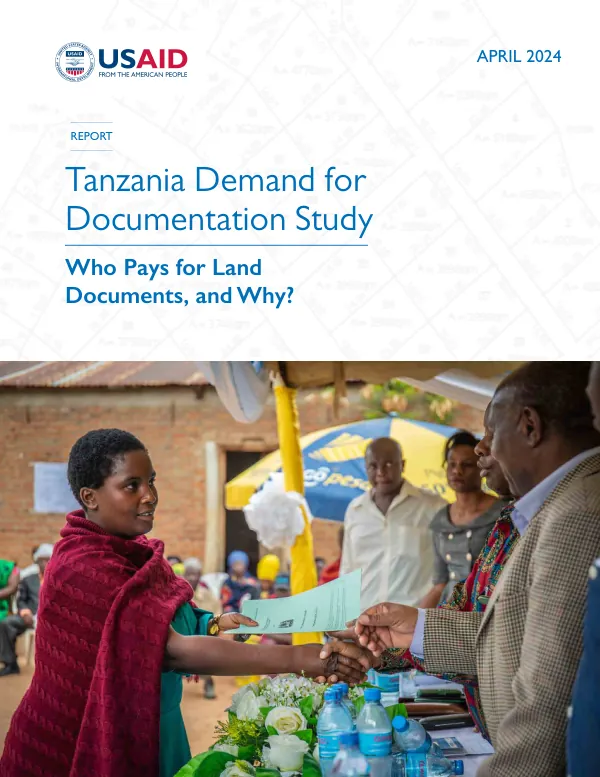
Initial assessments identified challenges in land documentation, with many landholders lacking formal recognition of their land rights. The LTA activity aimed to address these issues by providing Certificates of Customary Right of Occupancy (CCROs) to landholders. Implementation focused on three key interventions: land tenure assistance, infrastructure development, and market linkage facilitation. The program operated in two phases, initially providing CCROs to landholders for free, and then requiring landholders to pay a nominal fee to obtain the document. The study utilized a mixed methods approach, drawing on analysis of land registry data, a follow-up household survey, and qualitative data collection. The results showed that parcel size, occupancy type, claimant age, marital status, and marital status were significantly associated with the likelihood of CCRO payment. The proportion of parcels paid for varied widely across villages, but was not associated with proxies for village market, land use, or wealth. The follow-up phase focused on additional aspects of the village context that could shape payment rates. Among the 785 respondents reported via the survey, landholders' primary motivation for purchasing a CCRO was to increase their land tenure security. Respondents prioritized CCROs for larger, more fertile, and more fertile parcels that contained their homes or contained their home. Among the 31% of respondents who had not purchased a CCRO for at least one of their parcels, they overwhelmingly cited financial constraints rather than lack of interest in obtaining the document. The study found that the payment system was perceived as fair and affordable by most respondents. However, some respondents expressed concerns about the payment process, citing difficulties in accessing the payment system and concerns about the cost of the CCRO. The study suggests that the payment system could be improved by increasing transparency and reducing the cost of the CCRO. The study's findings have implications for land registration programming that aim for widespread uptake under a similar cost recovery model. The results suggest that targeting, barrier removal, and equity are critical considerations in designing effective land registration programs. The study's recommendations include increasing transparency and reducing the cost of the CCRO, as well as improving access to the payment system. The study's findings also highlight the importance of considering the village context in designing effective land registration programs. The study suggests that the village context, including factors such as market, land use, and wealth, can shape payment rates and influence the likelihood of CCRO payment. The study's recommendations include considering the village context in designing effective land registration programs and providing support to landholders who may face barriers in accessing the payment system. Overall, the study provides valuable insights into the factors that influence the willingness and ability of landholders to pay for land documents. The study's findings have implications for land registration programming and suggest that targeting, barrier removal, and equity are critical considerations in designing effective land registration programs.