USAID DEC
FY 18 Q3 Quarterly Report: April - June 2018 for Feed the Future Tanzania Land Tenure Assistance (LTA)
Sign inDAI GLOBAL, LLC
FY 18 Q3 Quarterly Report: April - June 2018 for Feed the Future Tanzania Land Tenure Assistance (LTA)
The Feed the Future Tanzania Land Tenure Assistance (LTA) program is a USAID-funded initiative aimed at improving land tenure security for rural communities in Tanzania.
2018 · 89 pages
Sign in to readA free account is required to download.
Abstract
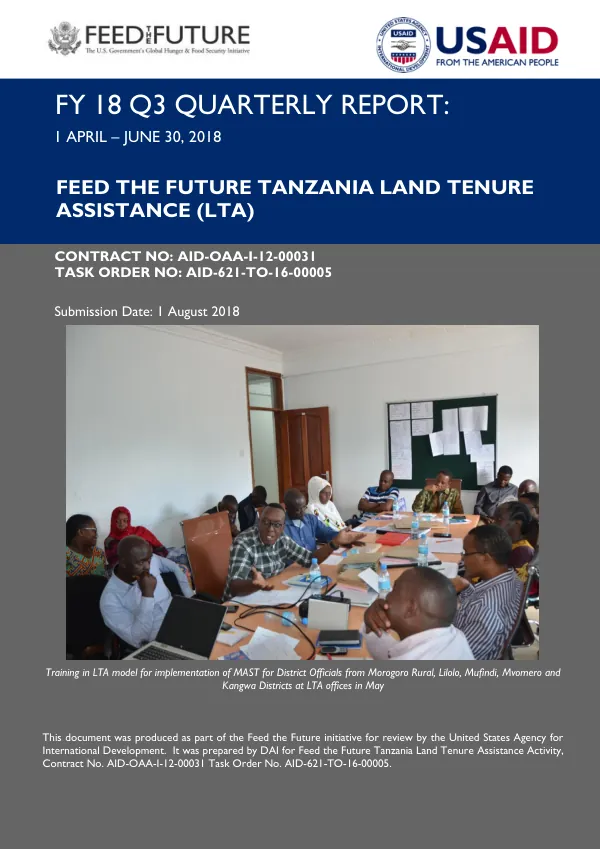
The program began in 2018 with the goal of enhancing land governance, increasing access to land information, and promoting sustainable land use practices. Implementation of the LTA program focused on several key interventions, including the development of a mobile application to secure tenure (MAST), the establishment of a land tenure support program (LTSP), and the provision of technical assistance to district lands offices (DLOs). The program also emphasized the importance of community engagement and participation in land governance processes. Training and capacity-building activities were conducted for district officials, village land use planners (VLUPs), and village land committees (VLCs) to enhance their understanding of land tenure issues and improve their ability to manage land resources effectively. The program also supported the development of village land use plans (VLUPs) and the registration of certificates of customary rights of occupancy (CCROs). Progress was made in the implementation of the LTA program during the third quarter of fiscal year 2018. A total of 15 villages in Iringa Region were mapped, and 12,000 parcels of land were registered. The program also conducted training sessions for 500 VLUPs and 200 VLCs. In addition, the program supported the establishment of 10 village land use plans and the registration of 1,500 CCROs. The LTA program also made progress in promoting gender equality and women's empowerment in land governance. Women's groups were formed or strengthened in 10 villages, and 500 women received training on land tenure issues. The program also supported the participation of women in village land use planning and decision-making processes. The program's performance was monitored and evaluated through a range of indicators, including the number of villages mapped, parcels of land registered, and CCROs issued. The program also conducted regular assessments of its progress against its objectives and made adjustments as necessary. The LTA program faced several implementation challenges during the third quarter of fiscal year 2018, including delays in the registration of CCROs and difficulties in engaging with some district officials. However, the program's implementing partners and USAID staff worked together to address these challenges and ensure the program's continued progress. The LTA program's success stories include the establishment of a functional land tenure support program in Iringa Region, the registration of thousands of parcels of land, and the empowerment of women in land governance. The program's lessons learned include the importance of community engagement and participation in land governance processes, the need for technical assistance to district officials, and the importance of monitoring and evaluation in ensuring program effectiveness. The LTA program's sustainability mechanisms include the establishment of a land tenure support program, the development of village land use plans, and the registration of CCROs. The program's observations on policy and governance include the need for stronger land governance institutions, the importance of community participation in land governance processes, and the need for greater transparency and accountability in land administration. The LTA program's local capacity observations include the need for greater technical assistance to district officials, the importance of community engagement and participation in land governance processes, and the need for greater capacity-building for VLUPs and VLCs. The program's key technical issue observations include the need for greater clarity on land tenure policies and procedures, the importance of data management infrastructure, and the need for greater technical assistance to district lands offices. The LTA program's success stories, lessons learned, sustainability mechanisms, policy and governance observations, local capacity observations, and key technical issue observations are presented in the annexes to this report.