FHI 360
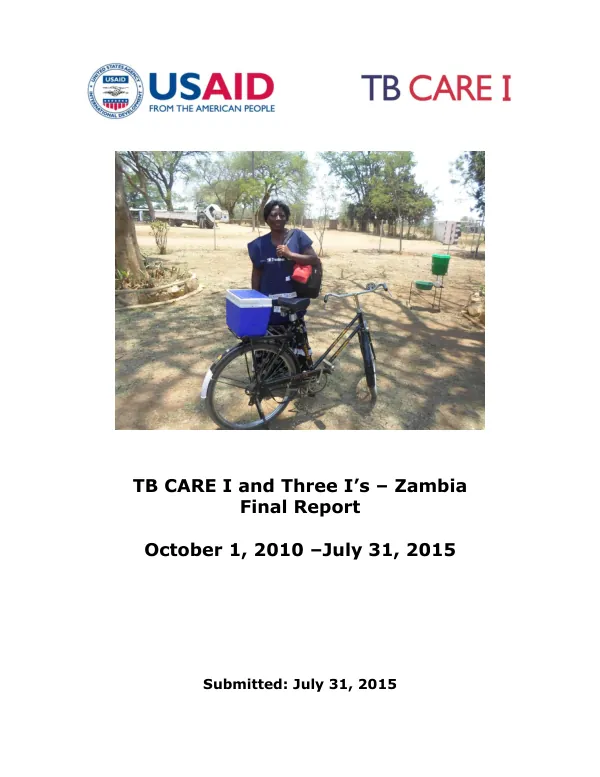
TB CARE I and Three I’s – Zambia Final Report
The TB CARE I project in Zambia was implemented from October 1, 2010, to July 31, 2015, with funding from the United States Agency for International Development (USAID) through a cooperative agreement with the KNCV Tuberculosis Foundation (KNCV).
2015 · 28 pages
Sign in to readA free account is required to download.
Abstract
The project aimed to support the Ministry of Health (MoH) and the Ministry of Community Development Mother and Child Health (MCDMCH) in their efforts to control tuberculosis (TB) in Zambia. The project was guided by a Scope of Work developed with the USAID mission, a memorandum of understanding with the Zambia Government, and a National TB Strategic Plan (2011-2015). The project focused on several key areas, including universal access to TB services, laboratory strengthening, infection control, TB/HIV collaboration, and health system strengthening. The project also supported the development of the Global Fund concept note and the National Health Strategic Plan. Key achievements were made in these areas, including the successful conduct of the first national TB prevalence survey, the development of the revised National TB Strategic Plan (2014-2016), and the provision of technical support for the grant writing process. The project also supported the engagement of community-based TB DOTS, with over 400 community volunteers trained in DOTS from year one to year five of project implementation in all six target provinces. Under the Three I's initiative, 125 community TB treatment supporters were actively engaged and retained for one year to support health facility and community level active case finding. The supporters traced 3,987 individuals who had contact with an individual diagnosed with TB in their households, and 109 (2.7%) of these contacts were diagnosed with TB. The project also enhanced the capacity, availability, and quality of laboratory testing with the provision of laboratory equipment, including 13 Xpert MTB/RIF machines, three MGIT machines, and one MTBDR genotype. The equipment enhanced diagnosis of TB from the national TB reference level to the regional and facility level laboratories. The project also provided training support in the use and maintenance of the Xpert MTB/RIF machine to the NTRL and diagnostic facilities in the Central and Copperbelt provinces. The project was implemented by a project team of thirty-nine staff members that provided technical, financial, administrative, and programmatic support to the national level NTP as well as to NTP in the six target provinces. The project was guided by national and international strategies in TB control, including the global Stop TB Strategy, the National TB Control Strategy (2011-2015 and 2014-2016), and the USAID Scope of Work (SoW). FHI360 was the coordinating partner, collaborating with MSH, WHO, and KNCV. The project provided key leadership in the provision of TB control activities towards the vision of creating a TB-free Zambia and the goal of reducing the prevalence of TB by 50% relative to the estimated 1990 levels by 2016 and sustaining the reduction in mortality. The project supported effective implementation of quality DOTS expansion and enhancement, resulting in a reduction in TB mortality. The project also supported the development of the National TB Strategic Plan (2014-2016) and the Global Fund concept note. The project's key achievements included the successful conduct of the first national TB prevalence survey, the development of the revised National TB Strategic Plan (2014-2016), and the provision of technical support for the grant writing process. The project also supported the engagement of community-based TB DOTS, with over 400 community volunteers trained in DOTS from year one to year five of project implementation in all six target provinces. The project also enhanced the capacity, availability, and quality of laboratory testing with the provision of laboratory equipment. The project's impact was significant, with a reduction in TB mortality and an increase in the availability and quality of TB services. The project's achievements were recognized by the Zambian government, which committed to sustaining the project's efforts in the future. The project's success was also recognized by the Global Fund, which provided funding for the project's activities. The project's legacy continues to be felt in Zambia, with ongoing efforts to control TB and improve the availability and quality of TB services.