USAID DEC
Tenure and Global Climate Change (TGCC) Zambia Pilot Impact Evaluation Pre-Analysis Plan
Sign inTHE CLOUDBURST GROUP
Tenure and Global Climate Change (TGCC) Zambia Pilot Impact Evaluation Pre-Analysis Plan
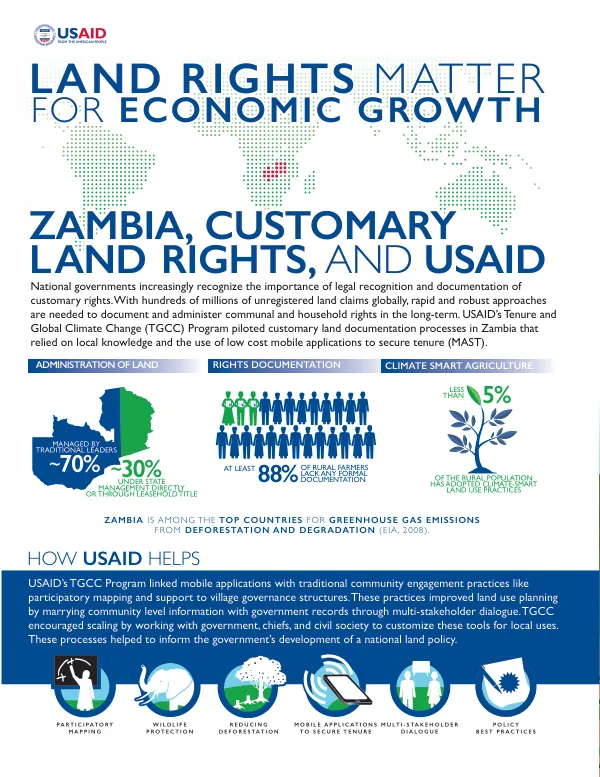
The USAID Tenure and Global Climate Change (TGCC) Zambia Climate Smart Agriculture (CSA) pilot is a 2.5-year intervention designed to increase tenure security while also supporting agroforestry extension services.
2017 · 57 pages
Sign in to readA free account is required to download.
Abstract
The TGCC pilot is being implemented in Chipata District, one of eight districts of Zambia's Eastern Province, from late summer 2014 through the end of 2016. TGCC is a program created by USAID to explore the relationship between security resource tenure and the achievement of climate change adaptation and mitigation goals. The TGCC interventions that comprise the focus of the evaluation are: 1) agroforestry extension in villages to facilitate tree planting and survivorship on smallholder farms; and 2) a village-level land tenure intervention consisting of participatory mapping, village headperson administration support, provision of land information, and dispute resolution, including the facilitation of customary land use certificates for households. The primary objective of the evaluation is to determine whether the village and household land tenure interventions under TGCC strengthen the security of land tenure and resource rights for smallholders, thereby increasing farmer investment in agroforestry and other climate smart agriculture practices. The overarching policy question of interest is: "How changes in property rights that strengthen a farmer's perception of long-term security over farmland affect a farmer's decision to practice climate smart agriculture, including agroforestry, on their own farms?" The evaluation breaks this question into two key research questions for hypothesis testing. First, does the intervention strengthen farmer's perception of tenure security? Second, does the intervention increase farmer investment in agroforestry and other climate smart agriculture practices? The evaluation will use a factorial design to compare the effects of the two interventions on farmer investment in agroforestry and other climate smart agriculture practices. The evaluation will collect data from 120 villages in Chipata District, with 60 villages receiving the land tenure intervention and 60 villages receiving the agroforestry extension intervention. The data will be collected through surveys, focus groups, and geospatial analysis. The evaluation will also collect data on the costs and benefits of the interventions, as well as the potential for scaling up the interventions to other districts in Zambia. The evaluation will use a variety of statistical methods to analyze the data, including regression analysis, regression discontinuity design, and geospatial analysis. The evaluation will also use a variety of indicators to measure the effects of the interventions, including farmer investment in agroforestry and other climate smart agriculture practices, farmer perception of tenure security, and household income and poverty. The evaluation will also examine the potential for spillovers from the interventions, including the potential for neighboring villages to adopt the interventions and the potential for the interventions to affect the broader agricultural sector in Chipata District. The evaluation will also examine the potential for the interventions to affect the broader policy and institutional context in Zambia, including the potential for the interventions to influence national policies and regulations related to land tenure and climate change. The evaluation will also examine the potential for the interventions to affect the broader social and environmental context in Chipata District, including the potential for the interventions to affect the livelihoods of smallholder farmers and the potential for the interventions to affect the natural resources in the district, including forests and water resources.