RTI INTERNATIONAL
The Cost of School-Related Gender-Based Violence
The cost of school-related gender-based violence (SRGBV) is a significant concern in the education sector, particularly in low and middle-income countries.
2015 · 2 pages
Sign in to readA free account is required to download.
Abstract
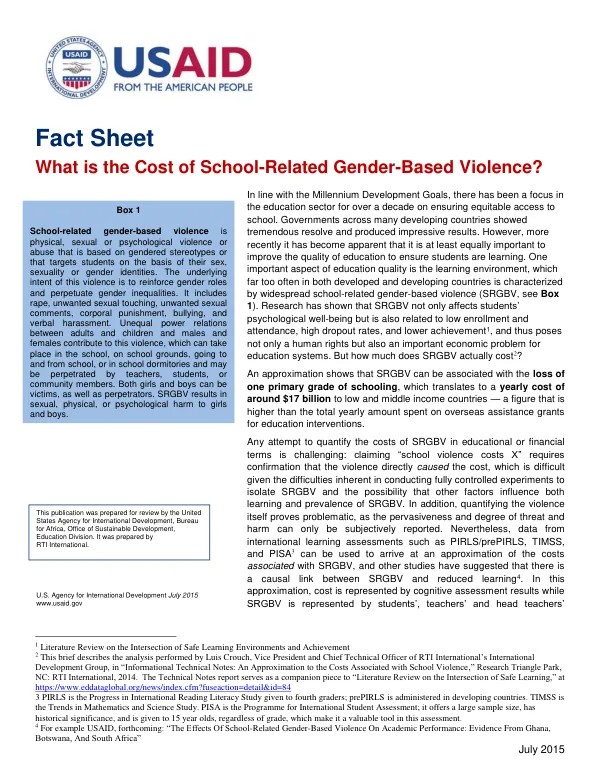
Research has shown that SRGBV affects students' psychological well-being, leads to low enrollment and attendance, high dropout rates, and lower achievement. The underlying intent of this violence is to reinforce gender roles and perpetuate gender inequalities. SRGBV can take many forms, including physical, sexual, or psychological violence, and can be perpetrated by teachers, students, or community members. Both girls and boys can be victims, as well as perpetrators. The pervasiveness and degree of threat and harm can only be subjectively reported, making it challenging to quantify the costs of SRGBV. An approximation of the costs associated with SRGBV was performed by Luis Crouch, Vice President and Chief Technical Officer of RTI International's International Development Group. The calculation used data from international learning assessments such as PIRLS, prePIRLS, TIMSS, and PISA to determine the differences in learning performance associated with the presence or absence of SRGBV. The results showed that the effect of school violence or lack of discipline and safety is comparable to the effect of losing one grade in primary school. The final step in the calculation was to determine what one year of primary education costs. Data from the World Bank EdStats database for low and lower-middle income countries provided reasonable figures for the calculation. The total GDP at $5.5 trillion in 2012, multiplied by the percent of GDP spent on education (the 2012 median of low and lower-middle income countries is 4.3%), multiplied by the percent of education funding spent on primary schooling (2012 median of low and lower-middle income countries is 42.9%), divided by the median duration of the primary cycle, which is 6 grades, results in $17 billion per year per grade spent on primary education in low and lower-middle income countries. This estimate is conservative, as it only includes children who actually stay in school to be tested, not those who drop out or don't enroll in the first place. It also does not include the possibly significant direct costs of school violence, such as diverting teacher and principal attention to the problem, requiring additional teachers or law enforcement resources, or additional time for ministry of education officials for dealing with cases of severe maltreatment. Furthermore, this estimate does not include the cost of any type of violence prevention programming. The yearly cost of school violence is estimated to be $17 billion, which is much higher than the entire yearly value of overseas development assistance for education, which is only $13 billion. This highlights the significant economic burden of SRGBV on countries least able to pay it. The long-term effects of violence can also be economically significant, with studies estimating that childhood experiences of abuse can reduce a person's earning potential by an average of about $5,000 per year.
Related documents