USAID DEC
The costs and outcomes of paediatric tuberculosis treatment at primary healthcare clinics in Johannesburg, South Africa
Sign inUNIVERSITY OF HOUSTON
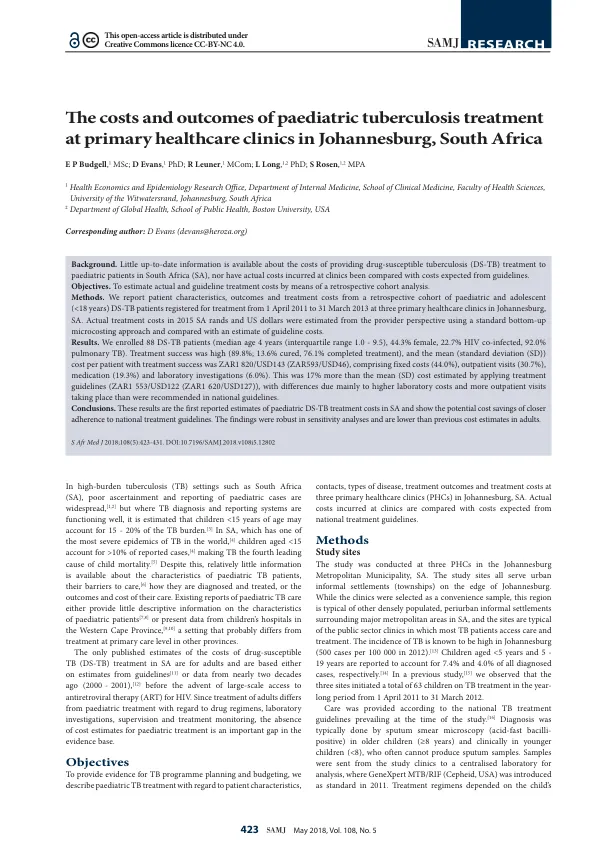
The costs and outcomes of paediatric tuberculosis treatment at primary healthcare clinics in Johannesburg, South Africa
Paediatric tuberculosis (TB) treatment in South Africa is a significant public health concern, with children under 15 years of age accounting for more than 10% of reported cases.
2018 · 9 pages
Sign in to readA free account is required to download.
Abstract
In Johannesburg, the incidence of TB is high, with 500 cases per 100,000 in 2012. Children under 5 years and 5-19 years account for 7.4% and 4.0% of all diagnosed cases, respectively. The national TB treatment guidelines prevailing at the time of the study were followed at the three primary healthcare clinics in Johannesburg. Diagnosis was typically done by sputum smear microscopy in older children and clinically in younger children. Treatment regimens depended on the child's age, history, and smear positivity. Patients with extrapulmonary TB or a clinical diagnosis were assessed through clinical monitoring. A retrospective cohort analysis was conducted to estimate actual and guideline treatment costs for paediatric and adolescent DS-TB patients registered for treatment from 1 April 2011 to 31 March 2013 at three primary healthcare clinics in Johannesburg. The study population consisted of 88 DS-TB patients, with a median age of 4 years, 44.3% female, 22.7% HIV co-infected, and 92.0% pulmonary TB. Treatment success was high, with 89.8% of patients achieving a successful outcome, defined as cured or completed treatment. The mean cost per patient with treatment success was ZAR1,820/USD143, comprising fixed costs (44.0%), outpatient visits (30.7%), medication (19.3%), and laboratory investigations (6.0%). This was 17% more than the mean cost estimated by applying treatment guidelines, with differences due mainly to higher laboratory costs and more outpatient visits taking place than recommended in national guidelines. The study found that the costs and outcomes of paediatric TB treatment at primary healthcare clinics in Johannesburg, South Africa, are significant. The findings highlight the potential cost savings of closer adherence to national treatment guidelines. The results are the first reported estimates of paediatric DS-TB treatment costs in South Africa and are lower than previous cost estimates in adults. The study population was created from a census of patients aged under 18 years registered for TB treatment at the study sites during the 2-year period 1 April 2011 - 31 March 2013. Data were extracted from routinely maintained TB case registers and National Tuberculosis Control Programme TB clinic cards stored at each site. The data collected included clinical characteristics at the time of treatment initiation, TB treatment history, diagnosis method, treatment start date, drug regimens, number of clinic visits, type of treatment supervisor, laboratory monitoring tests, patient contacts, and treatment outcomes. Treatment outcomes were defined as per national TB guidelines as cured, completed, failed, lost to follow-up, died, or transferred out. Baseline clinical characteristics, diagnosis method, smear conversion, drug regimens, contact tracing, directly observed treatment short-course (DOTS) supervision method, and treatment outcomes were reported and summarised as proportions or medians with interquartile ranges (IQRs). All patients in the cohort were included in the analysis of characteristics and outcomes. The cost of treatment for TB disease was estimated from the perspective of the healthcare provider using a bottom-up micro-costing approach, starting from the time of clinic registration to the earliest reported outcome. Patients who transferred out had an unknown outcome and were excluded from the cost estimates. For those with an outcome available, any treatment costs occurring before arrival at a study clinic or after loss to follow-up were unknown and were therefore excluded from the treatment cost estimates. Average treatment costs were estimated for the sample as a whole and by patient outcome. A 'production cost' or total cost per patient achieving a successful outcome (cured or completed) was also estimated, taking into account the costs of providing care to all patients. The study found that the costs and outcomes of paediatric TB treatment at primary healthcare clinics in Johannesburg, South Africa, are significant, and the findings highlight the potential cost savings of closer adherence to national treatment guidelines.
Related documents
Documents in this collection
 2015
2015USAID DEC
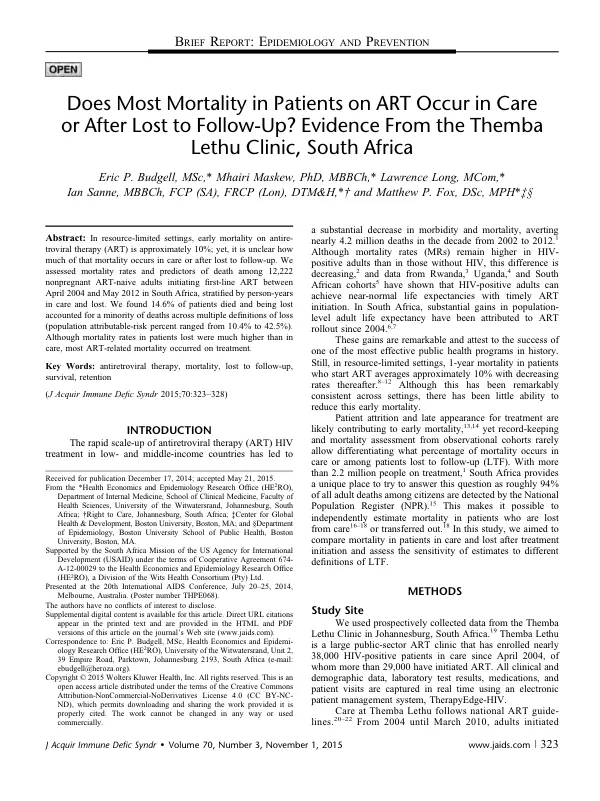
Does Most Mortality in Patients on ART Occur in Care or After Lost to Follow-Up? Evidence From the Themba Lethu Clinic, South Africa
Open record 2015
2015USAID DEC