CATHOLIC RELIEF SERVICES ORGANIZATION
The financing potential of the seed sector in Sub-Saharan Africa
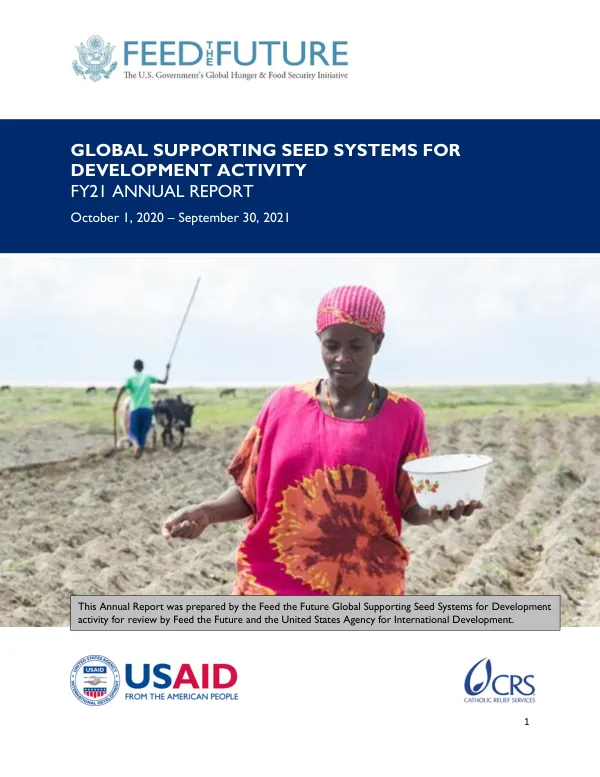
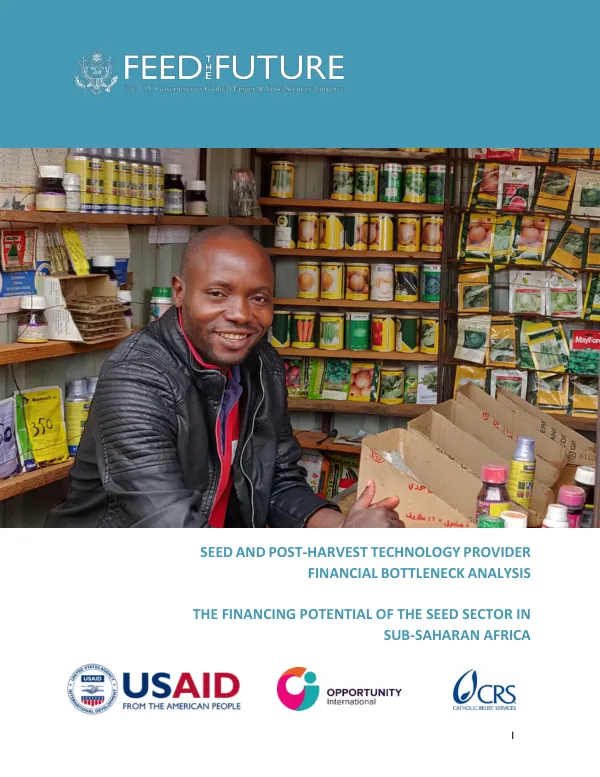
The Feed the Future Global Supporting Seed Systems for Development (S34D) activity is a five-year initiative aimed at improving smallholder farmers' crop production and resilience in Sub-Saharan Africa.
2019 · 37 pages
Sign in to readA free account is required to download.
Abstract
The activity is funded by the Feed the Future Initiative through USAID's Bureau for Resilience and Food Security (RFS) and by USAID through the Bureau for Humanitarian Assistance (BHA). The funding was granted to Catholic Relief Services as a Leader with Associates Cooperative Agreement award to implement the activity. The S34D activity focuses on developing high-impact, inclusive seed systems to improve smallholder farmers' crop production and resilience. The initiative targets Malawi, Uganda, Kenya, and Tanzania, with a goal of increasing access to financial services for seed sector actors in these countries. The activity is implemented in collaboration with consortium partners, including the Alliance of Bioversity International and International Center for Tropical Agriculture (ABC), International Fertilizer Development Center (IFDC), and Opportunity International Agriculture Finance (AgFinance). A concurrent assessment to the Supply-side Landscaping Report for the corridor, titled "The Financial Potential of the Seed Sector in Sub-Saharan Africa," was conducted to identify common demand-side challenges that are preventing seed sector actors from accessing and utilizing financial services. The assessment utilized a supply and demand framework to better understand bottlenecks and related solutions. The framework identified four quadrants, each representing a different combination of supply and demand for financial services. The assessment revealed that low profitability of agricultural loans disincentivizes agricultural lending, leading to a shortage of financial services for seed sector actors. Solutions that reduce operating costs for financial service providers, such as loan aggregation for rural clients, digitization, and process improvements, can make lending to seed systems actors more profitable. Additionally, information asymmetries exist between potential clients' financial needs and current offerings of financial products, which can be addressed through technical assistance and improvements in data collection and analysis. The assessment also highlighted the need for effective and clear risk mitigation mechanisms, such as loan loss guarantees, to reduce the costs of agricultural lending. Furthermore, low awareness of available financial products inhibits uptake, and encouraging financial service providers to partner with the breadth of seed systems actors can help facilitate effective trainings of potential rural client groups, improving their financial capacity to utilize loans and other products. The report provides additional detail on bottlenecks and mitigation strategies to help increase access to finance for seed sector actors throughout the corridor. The assessment identified five key bottlenecks that are limiting access to financial services for seed sector actors: low profitability of agricultural loans, information asymmetries, agricultural loans being riskier products, low awareness of available financial products, and poor design of financial products. The report recommends that financial service providers reduce operating costs through loan aggregation, digitization, and process improvements. It also suggests that financial service providers improve their capacity to design appropriate financial products that meet the seasonal cashflow needs of seed production and post-harvest technology provider clients. Furthermore, the report recommends that financial service providers implement effective and clear risk mitigation mechanisms, such as loan loss guarantees, to reduce the costs of agricultural lending. The assessment also highlights the importance of building the capacity of system actors while reducing barriers to accessing financial services. This can be achieved through the integration of appropriately designed financial products and simplified loan approval processes and requirements. The report provides a framework for understanding bottlenecks and related solutions, which can be used to inform future interventions aimed at increasing access to finance for seed sector actors throughout the corridor.