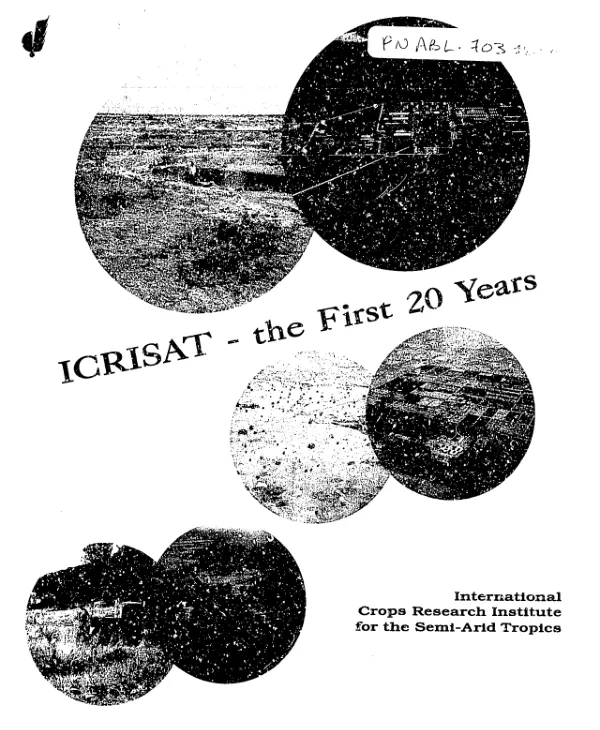
THE INTERNATIONAL CROPS RESEARCH INSTITUTE FOR THE SEMI-ARID TROPICS
The First 20 Years: ICRISAT's Story of High Endeavor and Achievement
The International Crops Research Institute for the Semi-Arid Tropics (ICRISAT) was founded in 1972 as the first center under the Consultative Group on International Agricultural Research (CGIAR).
2010 · 20 pages
Sign in to readA free account is required to download.
Abstract
The institute's primary goal is to improve the quality of life for people living in the semi-arid tropics by improving the reliability and productivity of their food crops. ICRISAT serves as a world center for the improvement of grain yield and quality of sorghum, millets, chickpea, pigeonpea, and groundnut, and acts as a world repository for the genetic resources of these crops. ICRISAT's genebank has accumulated a vast collection of germplasm from around the world, with over 33,000 accessions of sorghum, 22,000 accessions of pearl millet, 16,000 accessions of chickpea, 12,000 accessions of pigeonpea, 13,000 accessions of groundnut, and 2,000 accessions of minor millets. This collection has been accumulated through gifts and exchanges with international organizations and national programs, as well as through collection missions by ICRISAT scientists. The institute shares its collections with national agricultural research systems (NARSs) and local farmers, who generously share their material for evaluation and breeding programs. ICRISAT's scientists have made significant contributions to crop improvement, including the development of improved farming systems that increase and stabilize agricultural production through more effective use of natural and human resources in the semi-arid tropics. The institute has developed the graded broadbed and furrow and fertility management system, which allows farmers to grow two crops a year in areas where previously only one crop could be grown. This system has been shown to reduce soil erosion and increase soil moisture, resulting in higher crop yields. ICRISAT has also identified the importance of intercropping in traditional farming systems, and has conducted research on the best combinations of crops to increase yields and incomes. The institute has developed improved technologies for managing soil and water resources, including the use of windbreaks to reduce soil drift and conserve precious soil. In addition, ICRISAT has identified constraints to agricultural development in the semi-arid tropics, including saline soils, nutrient deficiencies, and acidity and aluminium toxicity, and has developed means of alleviating these constraints through technological and institutional changes. The institute's research has focused on the semi-arid tropics, where the environment is harsh and water is scarce. ICRISAT's scientists have worked with local farmers and NARSs to develop and implement improved farming systems that are adapted to the local conditions. The institute's research has shown that improved farming systems can increase crop yields, reduce soil erosion, and improve the livelihoods of farmers in the semi-arid tropics.
Related documents