USAID DEC
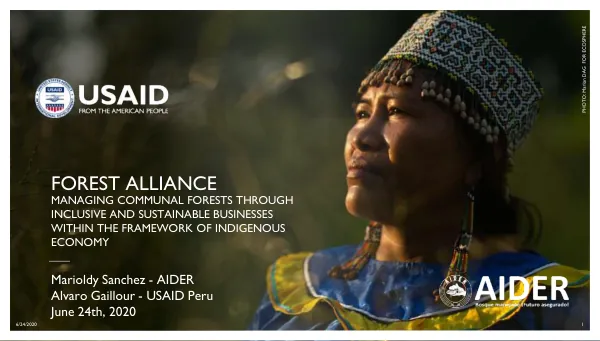
The Forest Alliance: Sustainable Business for Community Forest Management in Ucayali
Sign inAIDER
The Forest Alliance: Sustainable Business for Community Forest Management in Ucayali
The Forest Alliance, a sustainable business initiative for community forest management in Ucayali, began on April 1, 2019.
2020 · 139 pages
Sign in to readA free account is required to download.
Abstract
The program aims to conserve and sustainably manage forests on native community lands, including the restoration of degraded lands, and to scale up an innovative Communal Forest Management (CFM) model contributing to lower GHG emissions and the well-being of indigenous people of the Peruvian Amazon. The direct beneficiaries are seven native communities located in the Ucayali region. The Forest Alliance expects three results and six intermediate results. Result 1 focuses on strengthening enabling conditions for CFM in Ucayali, including indigenous land control and monitoring, local, regional, and national MRV systems, and public budget availability. Result 2 aims to improve the livelihoods of native communities through the creation and strengthening of sustainable forest businesses, including non-timber forest products, wood production, agroforestry, and forest plantations. Result 3 involves transferring the CFM model to key stakeholders, including public and private sector alliances and CFM platforms. The Forest Alliance contributes to the security of indigenous land tenure through technical assistance and property titles registration advisory for the seven native communities. Georeferencing processes in the seven communities are underway, with five communities completing the field geo-referencing of their lands with direct project support. The Sinchi Roca community obtained Regional Director Resolution No. 112-2020-GRU, approving the registration in SUNARP of the georeferenced plan of the communal title with the largest surface area, for an area of 25,444.93 hectares. The program also supports the development of sustainable forest businesses, including non-timber forest products, wood production, agroforestry, and forest plantations. The Forest Alliance has inserted non-timber forest products from indigenous forests into sustainable value chains, and forests in native communities are being used in a sustainable way for wood production. Degraded indigenous lands are being restored for commercial purposes through agroforestry and forest plantations. In addition, the Forest Alliance has strengthened indigenous company and business organizations to commercialize forest products. The program has also developed and implemented a CFM learning program, which is being promoted by indigenous organizations and authorities, and other key stakeholders to scale up the CFM model. CFM platforms have been consolidated and are in operation in partnership with the government and civil society. The Forest Alliance has made significant progress in strengthening enabling conditions for CFM in Ucayali, including indigenous land control and monitoring, local, regional, and national MRV systems, and public budget availability. The program has also improved the livelihoods of native communities through the creation and strengthening of sustainable forest businesses, and has transferred the CFM model to key stakeholders.
Related documents