TEXAS A&M INTERNATIONAL UNIVERSITY
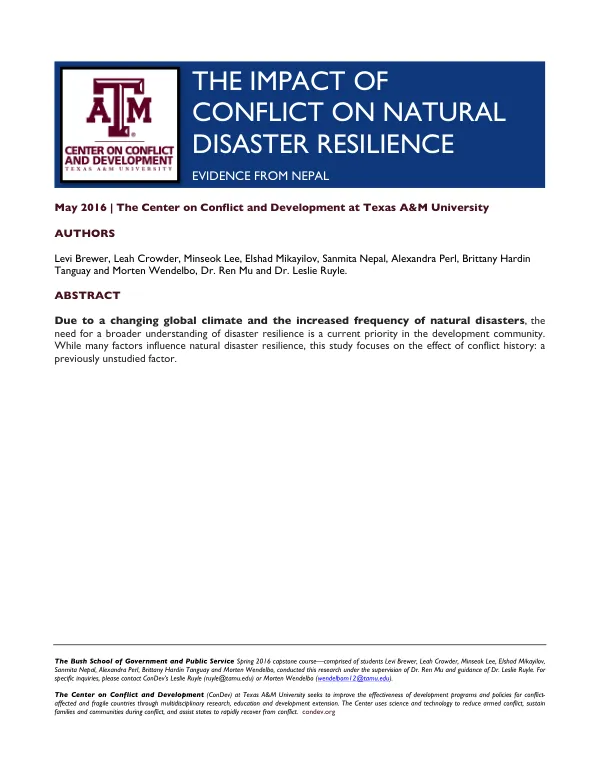
The Impact of Conflict on Natural Disaster Resilience: Evidence from Nepal
The Center on Conflict and Development at Texas A&M University conducted research on the impact of conflict on natural disaster resilience in Nepal.
2016 · 3 pages
Sign in to readA free account is required to download.
Abstract
The study focused on the effect of conflict history on the degree of damage resulting from the 2015 earthquakes. A conceptual framework derived from the literature review highlights channels through which history of conflict may impact natural disaster resilience. The armed conflict in Nepal began in 1996 and lasted for ten years, resulting in 3,030 conflict events and 16,278 fatalities. The conflict ended with the Comprehensive Peace Agreement in 2006. In 2015, Nepal was struck by major earthquakes that inflicted damage on all aspects of society and devastated many communities. The earthquakes resulted in enormous damages and losses and are considered the greatest natural disaster events to hit Nepal in over eighty years. Empirical findings indicate that districts with more intensified conflict episodes during the armed conflict in Nepal suffered more damages in the 2015 earthquakes. Additionally, the authors find that the importance of conflict history is greater in districts that experienced more severe earthquakes. The study suggests a negative relationship between conflict and education, with conflict events resulting in a reduction of school expenditures and enrollment. Households with higher levels of education see a reduction in damages due to disaster. The study also highlights the long-term negative consequences of conflict on the health of civilian populations. Civilians are less likely to stay during conflict and are not likely to return after the conflict has ended. Damage to health infrastructure decreases population health levels during a conflict. The impact of low health levels on natural disaster resilience is evident in many studies, with individuals who are malnourished and/or have a weakened immune system being particularly vulnerable when disaster strikes. The research used data from various sources, including the Ministry of Home Affairs in Nepal, the United Nations Office for the Coordination of Humanitarian Affairs, and the National Seismological Centre in Nepal. An attenuation model of ground-shaking was used to construct a district-specific measure of earthquake shaking, which takes into account the magnitudes of all aftershocks and the distances from district centers to the epicenters of the shocks. Ordinary least squares regression method was applied to control for earthquake shaking and various district characteristics in the regressions. The regression results show that an increase in the occurrence of conflict events between 1996 and 2006 is associated with a large increase in damage after the 2015 earthquakes. More specifically, for every conflict event a district experienced during the 1996-2006 period, the damage after the 2015 earthquakes increased by a certain amount. The study suggests that a history of conflict should be used as a predictor for potential weak resilience during and directly after a natural disaster. The research has several policy implications. First, frameworks and models can be developed to forecast areas that could be most adversely affected by natural disasters. Second, place additional emphasis on disaster resilience in former conflict areas. In disaster-prone regions, NGOs and aid organizations should emphasize natural disaster preparedness in prior conflict zones. This would include preparations and emergency-preparedness measures taken before the natural disaster, training on what to do during the natural disaster, and assistance rebuilding following a natural disaster. Third, NGOs and aid organizations should remain alert to continued aftershocks. While the focus of attention tends to be the first two largest earthquakes in Nepal, aftershocks can be damaging in vulnerable areas.
Related documents
Documents in this collection
 2021
2021USAID DEC
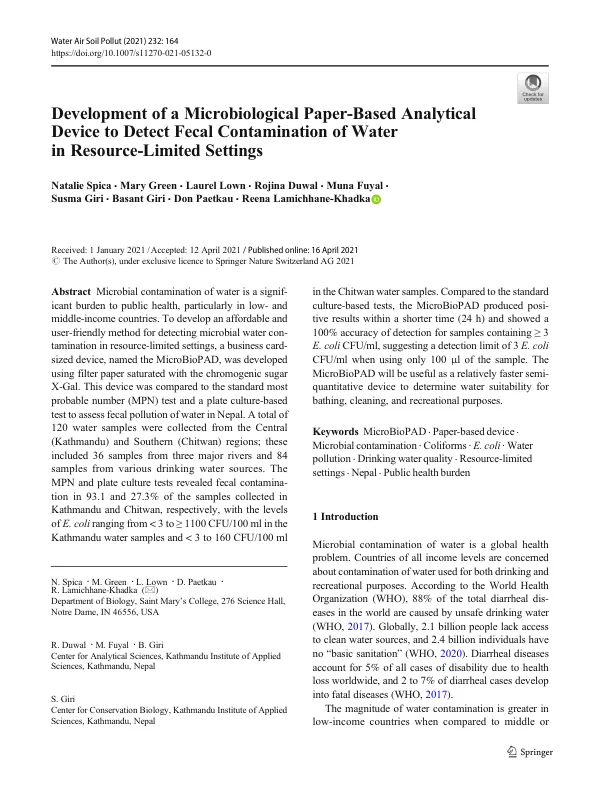
Development of a Microbiological Paper-Based Analytical Device to Detect Fecal Contamination of Water in Resource-Limited Settings
Open record 2021
2021USAID DEC