USAID DEC
The Impact of Water Reservoirs on Biodiversity and Food Security and the Creation of Adaptation Mechanisms
Sign inUSAID DEC
The Impact of Water Reservoirs on Biodiversity and Food Security and the Creation of Adaptation Mechanisms
The agricultural development initiative in Central Asia began with the consideration of problems related to food security and the preservation of reserved zones under the conditions of climate change induced by the placement and construction of large reservoirs.
2016 · 7 pages
Sign in to readA free account is required to download.
Abstract
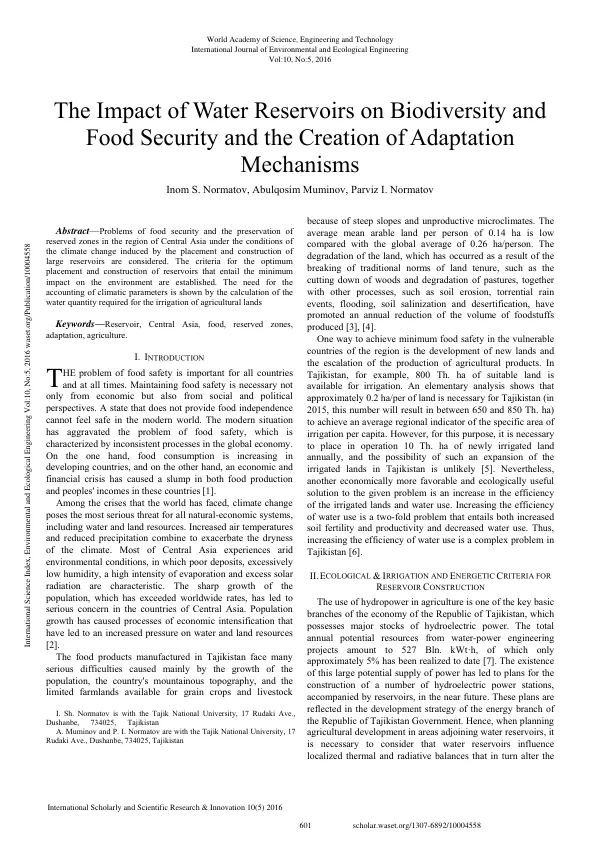
The criteria for the optimum placement and construction of reservoirs that entail the minimum impact on the environment were established. The need for accounting of climatic parameters was shown by the calculation of the water quantity required for the irrigation of agricultural lands. The average mean arable land per person in Central Asia is low compared to the global average, and the degradation of the land has occurred as a result of the breaking of traditional norms of land tenure, such as the cutting down of woods and degradation of pastures. Soil erosion, torrential rain events, flooding, soil salinization, and desertification have promoted an annual reduction of the volume of foodstuffs produced. In Tajikistan, for example, 800 Th. ha of suitable land is available for irrigation, but approximately 0.2 ha/person is necessary to achieve an average regional indicator of the specific area of irrigation per capita. Implementation of new lands and the escalation of the production of agricultural products is one way to achieve minimum food safety in the vulnerable countries of the region. However, increasing the efficiency of the irrigated lands and water use is a more economically favorable and ecologically useful solution to the given problem. This involves both increased soil fertility and productivity and decreased water use. In Tajikistan, increasing the efficiency of water use is a complex problem. The use of hydropower in agriculture is one of the key basic branches of the economy of the Republic of Tajikistan, which possesses major stocks of hydroelectric power. The total annual potential resources from water-power engineering projects amount to 527 Bln. kWt·h, of which only approximately 5% has been realized to date. When planning agricultural development in areas adjoining water reservoirs, it is necessary to consider that water reservoirs influence localized thermal and radiative balances that in turn alter the climatic characteristics over the reservoir and its adjoining lands. The physical, biogeochemical, and biological processes occurring within a reservoir can affect the temperature and chemical composition of the water leaving the system to such an extent that its quality upon release no longer resembles that of the inflows. The degree to which water quality is affected depends on factors such as the surface to volume ratio and depth of the reservoir, the geology and soil geochemistry of the surrounding catchment, the latitude of the reservoir, the rate and magnitude of sedimentation, the magnitude and timing of incoming flows and their residency time, and the level of biological productivity in the reservoir. Studies of changes in water temperature along the length of the river after discharge from reservoirs show that the influence of large reservoirs on water temperature is substantial. The daily and decadal scale change in water temperature before and after a reservoir is constructed can reach 8-12 °C. The greatest difference in average monthly water temperatures in the tail water of reservoirs before and after the construction of a reservoir occurs in November-January, reaching 4.2-3.4 °C in the Vakhsh River. The warming influence of the waters discharged from large reservoirs lasts for 8 months, and the cooling influence for four months.
Related documents