USAID DEC
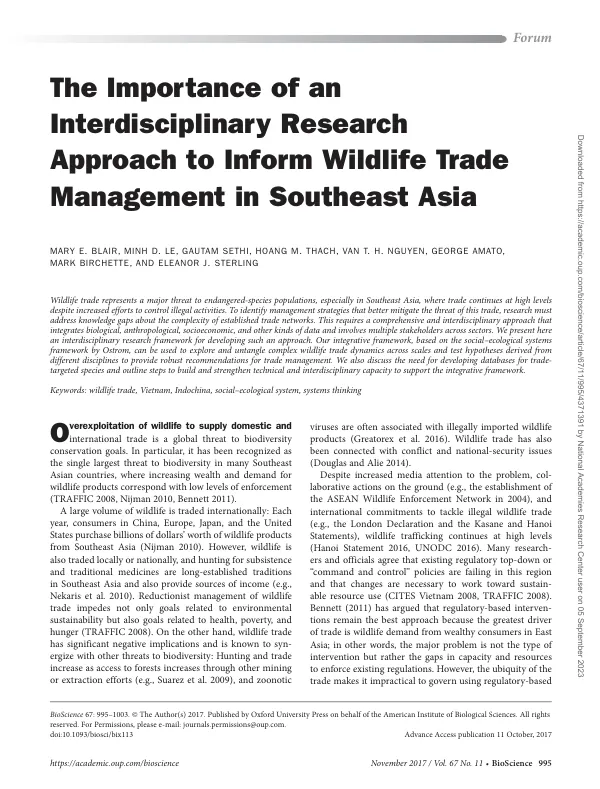
The Importance of an Interdisciplinary Research Approach to Inform Wildlife Trade Management in Southeast Asia
Sign inUSAID DEC
The Importance of an Interdisciplinary Research Approach to Inform Wildlife Trade Management in Southeast Asia
Wildlife trade in Southeast Asia represents a significant threat to biodiversity, particularly in regions where trade occurs at high levels despite increased efforts to control it.
2017 · 9 pages
Sign in to readA free account is required to download.
Abstract
The complexity of established trade networks in the region necessitates a comprehensive and interdisciplinary approach to mitigate this threat. This approach must integrate biological, anthropological, socioeconomic, and socioeconomic data and involve multiple stakeholders across sectors. A social–ecological systems framework can be used to develop an integrative framework for studying wildlife trade dynamics across scales and testing hypotheses derived from different disciplines. This framework can provide robust recommendations for trade management. Developing databases for trade-targeted species is also essential to support the integrative framework. The overexploitation of wildlife to supply domestic and international trade is a global threat to biodiversity conservation. In Southeast Asia, this threat is exacerbated by increasing wealth and demand for wildlife products, coupled with low levels of enforcement. A large volume of wildlife is traded internationally, with consumers in China, Japan, and the United States purchasing billions of dollars' worth of wildlife products from Southeast Asia. Wildlife is also traded locally or nationally, and hunting for subsistence and traditional medicines is a long-established tradition in Southeast Asia. Reductionist management of wildlife trade impedes goals related to environmental sustainability, health, poverty, and hunger. On the other hand, wildlife trade has significant negative implications and is known to synthesize with other threats to biodiversity. Wildlife trade has been connected to conflict and national-security issues, and despite increased media attention to the problem, wildlife trafficking continues at high levels. Existing regulatory top-down policies are failing, and changes are necessary to work toward sustainable resource use. Research must assess how nonregulatory incentives and interventions might be effective in mitigating the threat of wildlife trade. Market-based instruments, such as regulated trade, ranching, and wildlife farming, are being debated regarding their application in Southeast Asia and at a global scale. Behind each of these arguments are assumptions about the specific drivers of wildlife trade in Southeast Asia. Several studies have shown how wild-meat overexploitation is driven by factors such as poverty, lack of alternatives to protein, conflicts, and the choice of policies and measures. To avoid developing management efforts and interventions based on thin evidence, several knowledge gaps should be addressed. These gaps include the complexity of wildlife trade chains and socioeconomic drivers of trade. The complexity of wildlife trade in Southeast Asia stems from traditional cultural values relating to wildlife and wildlife products. Some studies indicate that wealth and social status are stronger drivers of wildlife trade in Southeast Asia than poverty, with urban consumers driving demand for wildlife products more than local subsistence in some cases. However, other studies show that most wildlife is still traded locally in rural areas. There are diverse actors with multiple backgrounds along trade chains in Southeast Asia, and their actions are shaped by factors such as financial gain, social esteem, cultural identity, and customs. Interdisciplinary research approaches that integrate socioeconomic, anthropological, psychological, governance, and biological data across multiple scales are necessary to understand the dynamics of wildlife trade. These approaches can help identify the specific drivers of wildlife trade in Southeast Asia and inform management efforts.
Related documents