JOINT UNITED NATIONS PROGRAMME ON HIV/AIDS , GENEVA
The Potential Cost and Impact of Expanding Male Circumcision in Malawi
Scaling up male circumcision to reach 80 percent of adult males in Malawi by 2015 would avert more than 265,000 adult HIV infections cumulatively between 2009 and 2025.
2009 · 8 pages
Sign in to readA free account is required to download.
Abstract
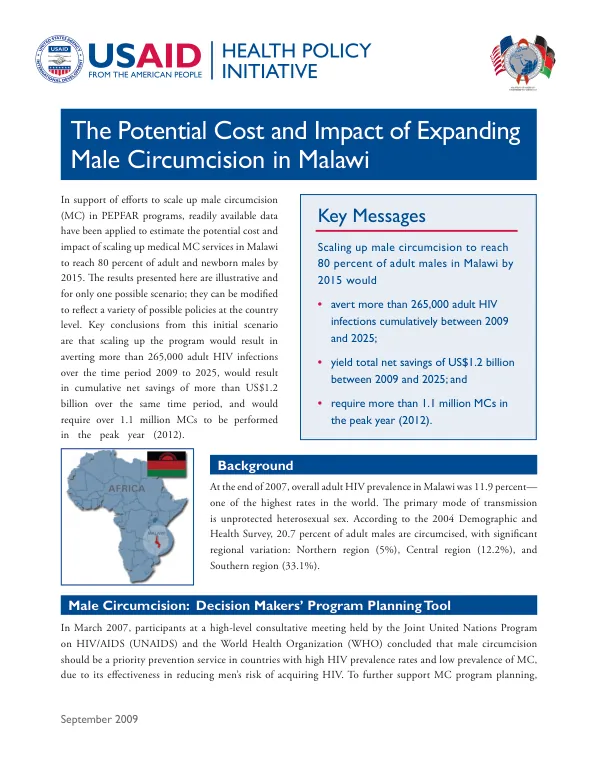
This would also yield total net savings of US$1.2 billion between 2009 and 2025. The program would require more than 1.1 million medical male circumcisions (MCs) in the peak year (2012). The potential cost and impact of expanding male circumcision in Malawi were estimated using readily available data to support efforts to scale up medical MC services in PEPFAR. The results presented are for one scenario and can be adjusted to reflect different policies at the country level. Scaling up the program would result in a large increase in the number of new MCs required per year in the short term, peaking at over 1.1 million in 2012 before reaching a new equilibrium of about 250,000 annually. The number of adult HIV infections averted is displayed in Figure 3. The dramatic impact of MC is evident, with more than 265,000 adult HIV infections averted due to scaling up medical MC services. The number of MCs performed per adult HIV infection averted is high in the short term but declines over time, reaching 15.4 in the time period 2016-2025. Assuming that 80 percent of new MCs are provided through the public sector and 20 percent are provided through the private sector, the total annual costs of scaling up MC services are shown in Figure 5. The underlying unit cost assumptions for both adult and newborn MCs are listed in Table 2 in the Annex. The total annual costs peak at about US$40 million in 2012, a US$38.5 million increase over current MC expenditure levels. The discounted net cost savings in millions of US dollars are displayed in Figure 6. The cumulative net cost savings reach more than US$1.2 billion by 2025. The discounted net cost per adult HIV infection averted is the cumulative incremental net cost incurred through implementing the scaled-up MC program, divided by the cumulative number of adult HIV infections averted over the relevant timeframe and discounted appropriately. The discounted net cost savings per adult HIV infection averted are also calculated using the results above. The discounted net cost per adult HIV infection averted is the cumulative incremental net cost incurred through implementing the scaled-up MC program, divided by the cumulative number of adult HIV infections averted over the relevant timeframe and discounted appropriately. The results are displayed in Figure 6. The net cost per adult HIV infection averted drops substantially in the longer term, from US$2,475 to US$922 once the number of adult HIV infections averted increases. The cumulative net cost savings reach more than US$1.2 billion by 2025. The discounted net cost savings per adult HIV infection averted are also calculated using the results above. The results of the model are shown in Figure 7. The model estimates the number of adult HIV infections averted, the number of MCs performed, and the total annual costs of scaling up MC services. The model also estimates the discounted net cost savings and the discounted net cost per adult HIV infection averted. The results are displayed in Figure 7. The model estimates that scaling up MC services would avert more than 265,000 adult HIV infections cumulatively between 2009 and 2025. This would also yield total net savings of US$1.2 billion between 2009 and 2025. The program would require more than 1.1 million medical male circumcisions (MCs) in the peak year (2012).
Related documents