USAID DEC
The Practitioners’ Guide to HEA
The Practitioners' Guide to HEA defines key terms and concepts related to household economy analysis.
2 pages
Sign in to readA free account is required to download.
Abstract
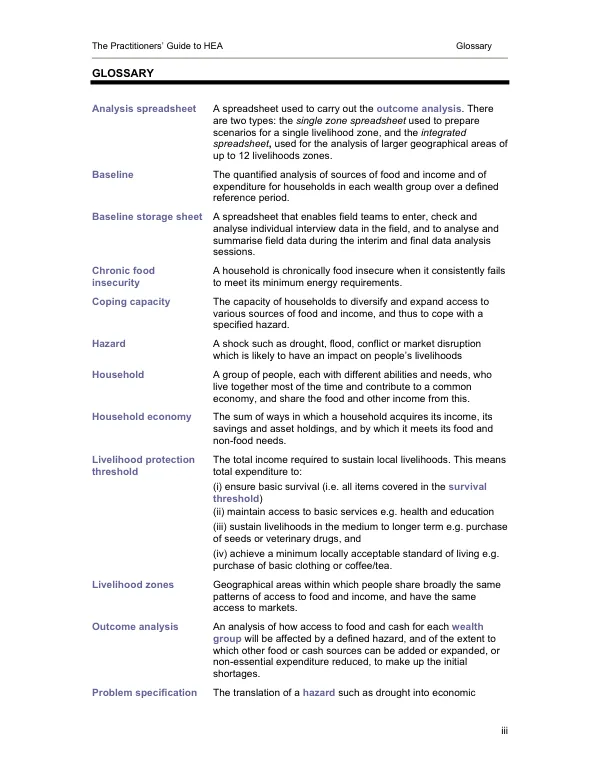
Analysis spreadsheets are used to carry out outcome analysis, with two types: single zone spreadsheets for a single livelihood zone and integrated spreadsheets for analysis of larger geographical areas of up to 12 livelihood zones. A baseline is a quantified analysis of sources of food and income and of expenditure for households in each wealth group over a defined reference period. The baseline storage sheet is a spreadsheet that enables field teams to enter, check, and analyze individual interview data in the field, and to analyze and summarize field data during interim and final data analysis sessions. Chronic food insecurity occurs when a household consistently fails to meet its minimum energy requirements. Coping capacity refers to the ability of households to diversify and expand access to various sources of food and income, and thus to cope with a specified hazard. A hazard is a shock such as drought, flood, conflict, or market disruption that is likely to have an impact on people's livelihoods. A household is defined as a group of people, each with different abilities and needs, who live together most of the time and contribute to a common economy, and share the food and other income from this. The household economy is the sum of ways in which a household acquires its income, its savings and asset holdings, and by which it meets its food and non-food needs. Livelihood protection threshold is the total income required to sustain local livelihoods, including basic survival, access to basic services, and maintenance of livelihoods in the medium to longer term. Livelihood zones are geographical areas within which people share broadly the same patterns of access to food and income, and have the same access to markets. Outcome analysis is an analysis of how access to food and cash for each wealth group will be affected by a defined hazard, and of the extent to which other food or cash sources can be added or expanded, or non-essential expenditure reduced, to make up the initial shortages. Problem specification is the translation of a hazard such as drought into economic consequences at household level. Projected outcome is a quantified estimate of access to food and cash, taking into account the shock and household responses to it, in relation to a survival and livelihoods protection threshold. A reference period is a defined period, typically 12 months, to which the baseline information refers, needed in order to analyze how changes in the future can be defined in relation to the baseline. Risk is the likelihood of a particular outcome, such as unusual hunger or food insecurity. Scenario outcome is a quantified estimate of access to food and cash arising from an outcome analysis, taking into account the effects of the hazard and household responses to it, for each of the wealth groups. A seasonal calendar is a graphical presentation of the months in which food and cash crop production and key food and income acquisition strategies take place, also showing key seasonal periods such as the rains, periods of peak illness, and the hunger season. Survival threshold is the total food and cash income required to cover the food and non-food items necessary for survival in the short term. Vulnerability refers to people who are expected to be unable to cope with a defined hazard, such as crop failure if such a hazard is likely to reduce their access to food or cash below a defined threshold. Wealth breakdown is the process by which people within a livelihood zone are grouped together using local definitions of wealth and the quantification of their assets. The level of division depends on how the community views their society, and the purpose of the analysis. A wealth group is a group of households within the same community who share similar capacities to exploit the different food and income options within a particular livelihood zone.